Fast, Reliable Attic Insulation Across Huntington Beach
Attic insulation in Huntington Beach usually costs between $1,800 and $4,200 for a full removal-and-reinsulation job, and $900 to $2,600 for a top-up or batt replacement. Most crews can be on-site within 48 hours, often same week. If your upstairs rooms run hot by late afternoon and cold by morning, the marine layer and salt air have probably done a number on what’s up there. Call (844) 948-3251 for a free attic assessment in Huntington Beach.
We work the coastal ZIPs 92648 and 92649 constantly, plus 92646 and 92647 inland. The failure pattern in Huntington Beach is not what most insulation guides describe. It’s moisture, not heat, that kills attics here. That changes how we approach every job.
Why Creekside Insulation Co Is Huntington Beach’s Preferred Attic Insulation Company
Noel Ibarra built Creekside Insulation Co around a simple idea: carry enough brands to recommend honestly, and know enough about local conditions to recommend correctly. That matters more in Huntington Beach than almost anywhere in Orange County. The salt-laden onshore breeze off the Pacific works on attic fasteners, staples, and radiant barrier hardware year after year. Crews that only look at R-value miss the failure that is actually happening up there.
We carry insulation from Owens Corning, Johns Manville, Knauf, and Rockwool, plus open- and closed-cell spray foam from Icynene and Demilec, and recycled cellulose from GreenFiber. Eight brands means the recommendation is driven by your home, not our warehouse. For a 1960s tract house near the beach in 92648, that might mean removing wet fiberglass and blowing in GreenFiber. For a dry 1970s home in 92647, it might simply mean topping up what’s settled. We do the work ourselves with the same crew across Attic Insulation projects, spray foam, and blown-in jobs. No subcontractors. No different crew showing up halfway through.
Attic Mold Removal in Huntington Beach
Attic mold removal in Huntington Beach is the job we get called for after a homeowner notices ceiling stains, a musty smell upstairs, or an inspector flags the attic during escrow. The marine layer keeps attic humidity high near the coast through much of the year, and when original insulation holds that moisture against the sheathing, mold follows. The removal job involves bagging and extracting contaminated insulation, treating the framing and sheathing to kill remaining spores, drying the attic properly, and then reinsulating with material suited to a coastal moisture environment. Homeowners in Huntington Beach can expect attic mold removal to run $1,200 to $3,800 depending on contaminated area size and whether insulation replacement is included. Call (844) 948-3251 for an exact quote.
Post-escrow mold findings
Huntington Beach real estate transactions routinely turn up attic mold during inspections, especially in 92648 and 92649 properties that have carried original insulation for decades. Buyers and sellers call us to remediate before closing. We move quickly on escrow deadlines, usually removing and treating within a week of the inspection report.
Treating the sheathing, not just the surface
If mold is present in a Huntington Beach attic, someone has to ask why. Usually the answer is compressed wet insulation against cold sheathing with corroded fasteners that let batts slump away from where they belong. We remove the source, treat the wood, and reinstall with materials and hardware that resist the salt-air deterioration that started the problem.
Attic Insulation Removal in Huntington Beach
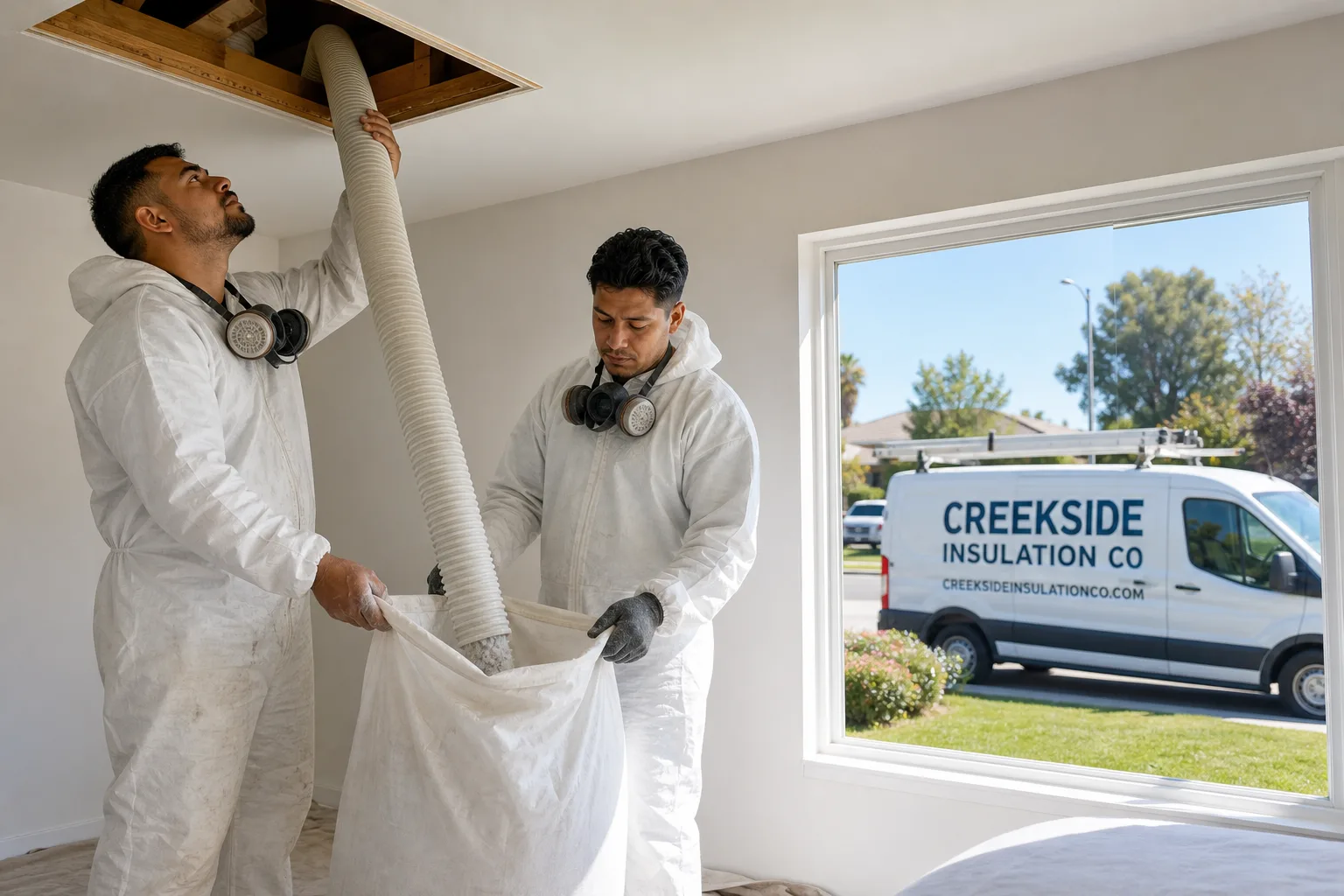
Attic insulation removal in Huntington Beach is not a formality before adding new material. In coastal ZIPs like 92648 and 92649, old fiberglass batts have often been breathing marine-layer dampness for decades. They sag, compress, and hold moisture against the sheathing. Removing them costs between $1.80 and $3.50 per square foot in Huntington Beach depending on attic access, insulation depth, and whether mold or rodent contamination is present. That is usually $900 to $2,300 for a typical single-family attic. We bag, HEPA-vacuum, and prep the space for new insulation that handles moisture correctly.
Wet batt extraction along the coast
The morning marine layer in Huntington Beach does not stay outside. It wicks into under-ventilated attics through soffit gaps and around recessed light fixtures, then condenses on the underside of cold sheathing. Original fiberglass batts soak it up. By the time we’re called, the batts are sagging between joists and the staples holding them look rusted. We remove the source, because no top-up fixes wet material.
Prepping for a correct reinstall
After extraction we address ventilation and air sealing before new insulation goes in. Attic baffles keep the soffit channels open so the marine-layer moisture has an exit path. Corrosion-resistant fasteners go in where old steel staples failed. Then the new insulation, selected for the home’s moisture profile, not just its R-value.
Trusted Brands We Service in Huntington Beach
Creekside Insulation Co installs products from eight manufacturers, including Owens Corning, Johns Manville, and Knauf for fiberglass batts, Rockwool for fire resistance and sound attenuation, Icynene and Demilec for open- and closed-cell spray foam, and GreenFiber for recycled cellulose. That breadth matters in Huntington Beach because a single-brand recommendation is usually a bias, not a diagnosis. We stock what coastal retrofits actually require locally, and we can source specialized products for Huntington Beach jobs without long waits. The right material for a 92648 beach bungalow and an inland 92647 tract house are often different things.
Common Attic Insulation Problems We See in Huntington Beach Homes
- Marine-layer moisture wicking into original fiberglass: Homes in 92648 and 92649 carry moisture from the morning marine layer into under-ventilated attics, where it concentrates against cold sheathing. Wet batts sag, compress, and lose effectiveness years before they age out.
- Salt-air corrosion on staples and fasteners: The onshore breeze carries salt that settles onto attic hardware. We routinely find rusted-through staples and radiant barrier attachments in coastal Huntington Beach attics, with batts slumping away from the roof deck.
- Thin or settled original insulation in postwar tracts: Huntington Beach’s dominant housing stock is the post-WWII and 1960s-70s tract boom spreading east from the coast. Many of those attics still hold original insulation that has settled to half its intended depth, so the home reads as constantly under-insulated.
- Condensation-driven mold on attic sheathing: High humidity near the coast combines with insufficient attic ventilation to wet the underside of roof sheathing. By the time a homeowner notices a ceiling stain, the mold has usually been growing for months.
Pricing for Attic Insulation in Huntington Beach, CA
A full attic insulation removal and reinsulation job in Huntington Beach runs $1,800 to $4,200 for a typical single-family home. A batt-only replacement in a 1,200 to 1,800 square foot attic runs $1,400 to $3,100. Blown-in top-ups over existing dry insulation range from $900 to $2,600 depending on material depth. Spray foam runs $2.20 to $4.80 per board foot installed, with open-cell Icynene or Demilec at the lower end and closed-cell formulations higher. Coastal ZIPs 92648 and 92649 often carry an extra step, remediation of moisture-compromised material or rusted hardware, which adds $300 to $900 depending on extent. Estimates are free, and an on-site inspection gives you a hard number. Call (844) 948-3251 for a Huntington Beach quote.
We Also Serve Cities Near Huntington Beach
Beyond Attic Insulation in Huntington Beach, our crews work neighboring Midway City, Fountain Valley, Westminster, and Costa Mesa. Homes in those areas share much of the same post-war housing stock and coastal influence. We schedule across all of them and often run multiple jobs in the same week throughout the area.
Serving Huntington Beach, CA — Our Local Coverage Area
We’re based in the Huntington Beach area and know this community well. Use the map below to see our service coverage — if you’re nearby, we can almost certainly help.
FAQs About Attic Insulation in Huntington Beach
The marine layer and salt-laden onshore breeze push humidity into coastal Huntington Beach attics, where moisture condenses on cool sheathing and wicks into fiberglass batts. Wet batts sag between joists and slowly compress under their own weight, losing R-value long before the material ages out. Call (844) 948-3251 for an inspection if your attic batts look flattened or damp.
Usually yes, because batts in coastal homes have often been exposed to marine-layer moisture and salt air for decades. Adding new insulation over wet, compressed, or moldy material traps the problem and makes remediation harder later. We inspect first and recommend removal only when the existing material is compromised.
We install products from Owens Corning, Johns Manville, Knauf, and Rockwool, plus Icynene and Demilec spray foam and GreenFiber recycled cellulose. For coastal homes in 92648 and 92649 we often pair GreenFiber blown-in with corrosion-resistant fasteners and improved ventilation, because moisture control matters as much as R-value here.
Salt-laden air accelerates corrosion on staples, fasteners, and radiant barrier attachments, especially in the coastal ZIPs 92648 and 92649. We routinely find rusted-through staples that have let batts slump away from the sheathing, which is why our reinstalls include corrosion-resistant hardware. This is a Huntington Beach-specific failure pattern we see far less often inland.
Yes. We remove mold-contaminated insulation, treat the affected sheathing and framing, dry the attic, and reinsulate with moisture-appropriate material. Mold discovered during retrofit work is common in Huntington Beach coastal homes, and we address it as part of the same job rather than stopping and sending you elsewhere. Call (844) 948-3251 for an assessment.
Written by Noel Ibarra, Owner at Creekside Insulation Co, serving Huntington Beach and surrounding Orange County communities.