
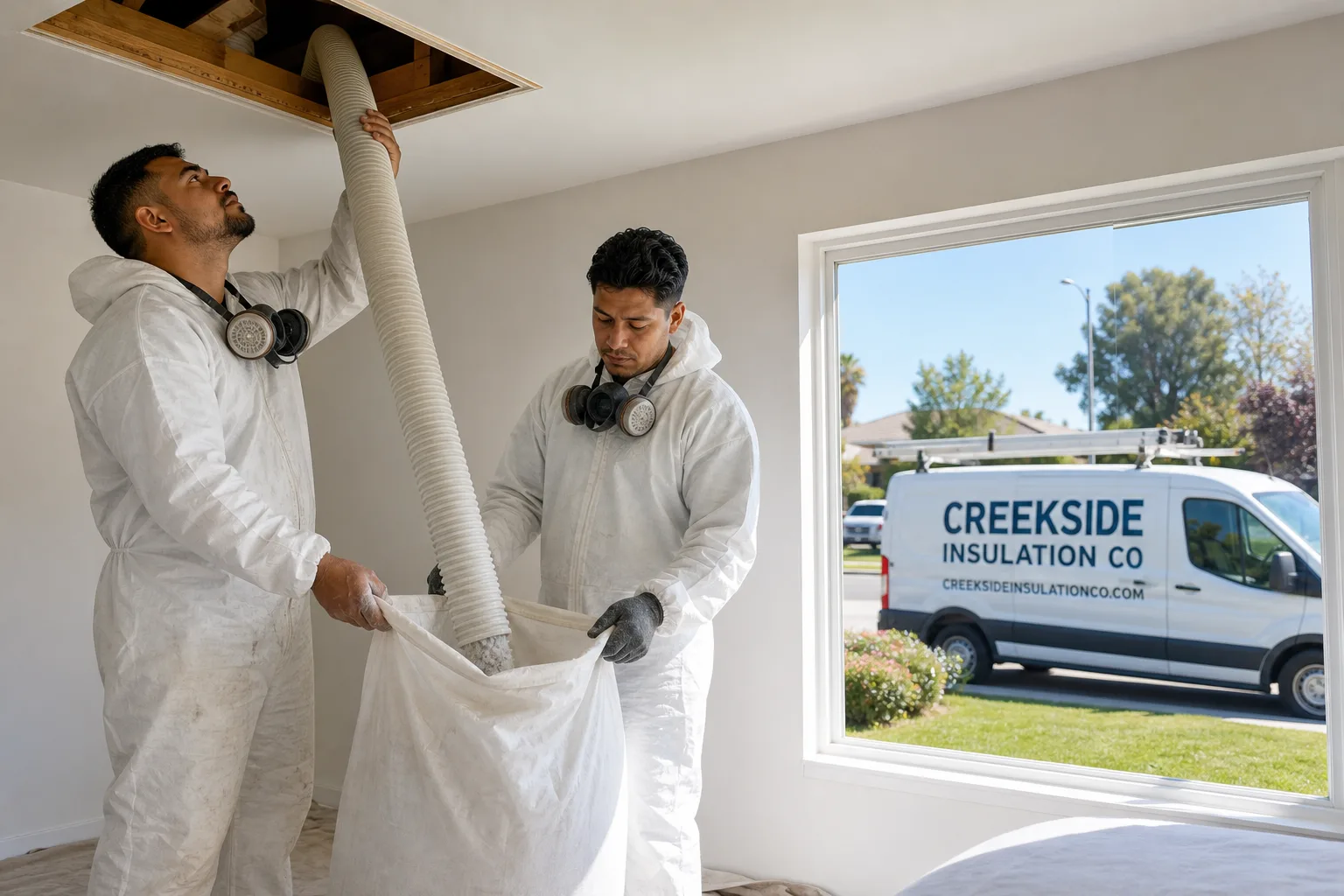
Fast, Reliable Spray Foam Insulation Across Rowland Heights
Spray foam insulation in Rowland Heights typically runs $2.50 to $6.50 per square foot installed, with most attic or garage projects landing between $1,800 and $6,200 depending on foam type, square footage, and how much prep the existing attic needs. Our crews know the tract homes along Colima Road, Fullerton Road, and Nogales Street well enough to tell you what you’re dealing with before we even climb the ladder. If your upstairs rooms bake after 2 p.m. or your garage feels like an oven by noon, give us a call at (844) 948-3251. We’ll come out, look at what’s actually going on in your attic, and give you an honest recommendation from our full product lineup.
Why Creekside Insulation Co Is Rowland Heights’s Preferred Spray Foam Insulation Company
Rowland Heights homeowners call us because we actually know this housing stock. Most of the homes we walk into were built between 1965 and 1985, which means wood-framed construction, stucco exteriors, and attic insulation that was thin by the standards of the day and has only settled further since. Our team is led by Noel Ibarra, and he’s spent years working through the specific failure modes these houses develop: dust-compressed fiberglass, gaping top plates, bathroom fans venting straight into the attic, and roof decks that hit 140°F every summer afternoon.
We are not a one-product crew pushing whatever’s cheapest to stock. We’re authorized to install products from eight manufacturers, including Owens Corning, Johns Manville, and Rockwool, and our spray foam work runs through Icynene and Demilec, two of the most respected foam brands in North America. That breadth matters here because the right answer for a 1972 tract house off Colima Road is not always the same as the right answer for a newer build near the Puente Hills. When we recommend something, it’s because that’s what your home’s thermal envelope actually needs.
We also understand that Rowland Heights sits in a unique position in the San Gabriel Valley. The 60 Freeway corridor runs right through the heart of the community, and the Puente Hills rise just to the south. Both features shape how attics behave here, and neither shows up in a generic insulation manual. That local knowledge is what lets us diagnose problems correctly the first time.
Why Your Attic Is Losing More Energy Than Any Other Part of Your Rowland Heights Home
Here’s the short answer: your attic is where the sun beats down hardest, and most Rowland Heights tract homes built from the 1960s through the 1980s were insulated for a different climate and a different era of energy prices. When it’s 95°F outside, the roof deck above your ceiling can exceed 140°F. If your attic has settled R-11 fiberglass batts or, worse, bare spots between the joists, that heat radiates straight down into your living space. Your AC runs longer, your upstairs rooms never quite cool off, and your bill climbs every month.
What we see most often in Rowland Heights is not missing insulation so much as insulation that’s given up. Decades of heat cycling compress fiberglass. Every Santa Ana wind event pushes dust and fine debris through gable vents and soffit gaps, and that dust settles into the insulation, matting it down and killing its loft. An R-19 batt that’s been flattened by forty years of dust and heat might be performing at R-8 or worse. The fix is not piling more fiberglass on top. The fix is removing what’s failed, air sealing the attic floor, and installing a material that won’t settle, won’t absorb dust, and creates an actual thermal barrier. That material is spray foam.
Garage Spray Foam Insulation in Rowland Heights
Garage spray foam insulation in Rowland Heights is one of the most common projects we take on, and it usually runs $900 to $2,800 depending on whether you’re doing the ceiling only, the ceiling plus one shared wall, or the full garage envelope. In Rowland Heights, a garage is rarely just a place to park. It’s a workshop, a home gym, a band practice room, or a storage space for the holiday decorations that would otherwise melt in July. The problem is that most garages here were built with zero insulation, and when the afternoon sun hits that uninsulated garage door and the ceiling below the attic, the temperature inside can climb past 110°F without much trouble.
Closed-cell foam on the garage ceiling does two things at once. It stops the radiant heat from the attic above, and it air seals the boundary between your garage and the rest of your home if there’s living space above. We also frequently foam the shared wall between the garage and the house, especially in older Rowland Heights floorplans where that wall was never insulated.
Shared Wall and Rim Joist Work
In many 1970s-era Rowland Heights homes, the wall between the garage and the living space has nothing in it but studs and drywall. That means conditioned air leaks out into the garage, and summer heat leaks back in. We foam those wall cavities and the rim joist where the floor framing meets the foundation, sealing the boundary in a way fiberglass never could.
Dust and Exhaust Sealing
If your garage shares a wall with a laundry room or bathroom, we pay special attention to the penetrations. Dryer vents, plumbing chases, and electrical runs all create pathways for hot, dusty air to move. Closed-cell foam locks those gaps shut, which matters in Rowland Heights where the 60 Freeway corridor keeps fine particulate matter moving through the air most days. For more on how we approach the full scope of this work, see our Spray Foam Insulation service overview.
Closed Cell Spray Foam Insulation in Rowland Heights
Closed cell spray foam insulation in Rowland Heights is what we recommend for the majority of attic applications here, and it typically runs $4.00 to $6.50 per square foot depending on depth and substrate condition. The reason is straightforward: closed-cell foam delivers about R-6.5 to R-7 per inch, creates a vapor barrier, and adds structural rigidity to the roof deck. In a climate where attic temperatures exceed 140°F for months at a time, that density matters.
Rows of tract homes near the 60 Freeway and the Puente Hills deal with something most insulation contractors never mention: wind-driven dust. Fine particulates blow up from the freeway corridor and through the hills, infiltrating attics through every soffit vent and gable gap. That dust settles on horizontal surfaces, works its way into exposed fiberglass, and contaminates the attic environment. Closed-cell foam, when applied to a properly cleaned and prepared surface, forms a monolithic barrier that dust cannot penetrate.
Roof Deck Applications
When we foam the roofline itself rather than the attic floor, we create a conditioned attic. That means the ductwork, the air handler, and everything else up there stays within a few degrees of the living space below instead of baking at 140°F. For Rowland Heights homes where the HVAC equipment lives in the attic, this is often the single biggest efficiency upgrade we can make.
Rim Joist and Crawl Space Work
Closed-cell foam also excels at the rim joist, the band of lumber where your floor framing meets your foundation. Those spaces leak air year-round, pulling in hot dry air in summer and letting whatever conditioned air you paid for escape. Sealing them with closed-cell foam stops the drafts at the source.
Trusted Brands We Service in Rowland Heights
We carry and install spray foam from Icynene and Demilec, two of the material’s most established manufacturers, and our credibility is anchored by an eight-brand portfolio that includes Owens Corning, Johns Manville, Knauf, and Rockwool. That range means we are never forced to recommend a product because it’s the only one we stock. When a Rowland Heights attic needs open-cell for a retrofit where sound control matters, we can do that. When it needs closed-cell to lock out 140°F radiant heat and dust from the 60 corridor, we can do that too. Eight brands, one honest recommendation.
Common Spray Foam Insulation Problems We See in Rowland Heights Homes
- Settled, dust-compressed original fiberglass in Colima Road-area 1970s homes. The fiberglass batts installed when these houses were built have been flattened by decades of heat and dust, leaving effective R-values far below what this climate requires. Foam applied directly over that settled material traps the debris and hides the thermal gap.
- Wind-driven dust and debris from the Puente Hills and 60 Freeway corridor contaminating attic surfaces. Santa Ana winds push fine particulates through vents and gaps, coating attic floors, joists, and existing insulation. If that dust layer isn’t vacuumed away before foam application, adhesion suffers and the foam can delaminate within a season or two.
- Thin or missing attic insulation in 1960s to 1980s tract homes letting attic heat exceed 140°F. When the original insulation fails, the attic becomes a heat reservoir. Poorly sealed foam edges exposed to those temperatures can blister and pull away from the hot roof deck, so proper edge sealing and application depth are critical.
- Bathroom exhaust fans and dryer vents dumping warm, humid air directly into the attic. Many original Rowland Heights builds vent these fixtures straight into attic space rather than through the roof. In dry summer months this adds heat; in winter it adds moisture. We correct the venting path before any foam work begins.
Pricing for Spray Foam Insulation in Rowland Heights, CA
Here’s what you can expect in the Rowland Heights market. Open-cell spray foam typically runs $2.50 to $4.00 per square foot for a standard attic or garage ceiling application. Closed-cell runs $4.00 to $6.50 per square foot because it delivers roughly double the R-value per inch and includes a vapor barrier. A typical garage ceiling job on a two-car garage lands between $1,100 and $2,200. A full attic lid on a 1,400-square-foot ranch runs $3,500 to $6,500. The biggest cost variables are debris removal from dust-contaminated attics, the condition of the existing insulation, and whether we’re foaming the attic floor or the roof deck. Every estimate is free, and we’ll walk you through the numbers before any work begins.
What Our Crews See in Rowland Heights Attics
On a 1972 stucco tract house off Colima Road, our crew found attic fiberglass settled to an R-value well under what the hot-summer climate demands, with a visible dust layer blown in from the 60 Freeway corridor. We vacuumed out the debris, air-sealed the top plates and penetrations, then applied closed-cell spray foam across the lid to lock out radiant heat and stop the dust intrusion. The homeowner reported the upstairs rooms holding temperature through the afternoon instead of spiking in the heat. That’s a specific job, but it’s a pattern we see all over Rowland Heights. Houses north of the 60, houses tucked up against the Puente Hills, houses along Fullerton Road where the afternoon sun is relentless all share the same underlying issues: original insulation that’s failed, attic envelopes that leak, and a climate that punishes both mistakes.
What makes Rowland Heights different from other San Gabriel Valley cities is the combination of aging tract housing and relentless dust exposure. Walnut and Hacienda Heights have newer stock in places. South San Jose Hills and Valinda share some of the same vintage, but the freeway corridor and the hills create a particular dust-loading pattern here that we plan for on every single job. If you want spray foam that stays adhered, performs for decades, and actually cuts your cooling bills, the prep work matters as much as the foam itself.
We Also Serve Cities Near Rowland Heights
Our crews regularly work in the communities surrounding Rowland Heights, including South San Jose Hills, Walnut, Valinda, and Hacienda Heights. If you’re in one of those areas and dealing with the same hot attic and dust problems we see throughout the eastern San Gabriel Valley, we can help. The same materials, the same prep standards, the same crew.
Serving Rowland Heights, CA — Our Local Coverage Area
We’re based in the Rowland Heights area and know this community well. Use the map below to see our service coverage — if you’re nearby, we can almost certainly help.
FAQs About Spray Foam Insulation in Rowland Heights
Your Rowland Heights attic gets hot because this inland valley climate produces long, dry, sunny summers, and your roof deck absorbs solar radiation all day long. On a 95°F afternoon, attic air can exceed 140°F even when the outside temperature feels manageable. Older tract homes with original or settled insulation have almost nothing slowing that heat transfer into the living space. The fix is an insulation layer dense enough to stop radiant heat, which is exactly what closed-cell spray foam does. Call (844) 948-3251 and we’ll take a look at your specific attic.
Yes, wind-driven dust from the 60 Freeway corridor directly affects spray foam work in Rowland Heights. Dust and fine particulates settle on attic surfaces and existing insulation, and if a contractor sprays foam directly over that contamination, the foam cannot bond properly to the substrate. That leads to delamination, air gaps, and failed insulation. Our crews always vacuum and prepare the surface before foam application. It’s not optional, not in this location.
Spray foam should not be applied directly over settled, dust-compressed insulation in Colima Road-area homes. The flattened material still traps heat and debris beneath the new foam, and the foam has nothing clean to adhere to anyway. The proper sequence is removal of the failed insulation, air sealing of top plates and penetrations, then foam application on a clean substrate. Our crews do this work regularly. For an exact price on your attic, call (844) 948-3251 for a free estimate.
For most Rowland Heights attics, closed-cell spray foam is the better choice because it delivers roughly R-6.5 to R-7 per inch and acts as a vapor and air barrier, which matters when attic temperatures exceed 140°F for months. Open-cell is more appropriate for interior sound-deadening applications or where budget constraints demand a less dense material at a lower cost per square foot. We install both types and will recommend the one that fits your home’s actual thermal and moisture profile, not whichever one happens to be on the truck. Call (844) 948-3251 to talk through it.
Yes, spray foam in the garage helps significantly with heat and dust in Rowland Heights. An uninsulated garage ceiling lets attic heat radiate straight down, turning the garage into an oven by mid-morning. Foaming the ceiling, shared wall, and rim joist stops that heat transfer and seals the gaps where dust from the 60 corridor enters. Expect a two-car garage ceiling to run $1,100 to $2,200. Call (844) 948-3251 and we’ll get you on the schedule.
Written by Noel Ibarra, owner of Creekside Insulation Co, serving Rowland Heights and the eastern San Gabriel Valley.
Ready to fix your attic for good? Call Creekside Insulation Co at (844) 948-3251 for a free estimate. We’ll come to your Rowland Heights home, diagnose what’s actually wrong, and give you a straight answer on what it’ll take to fix it.