
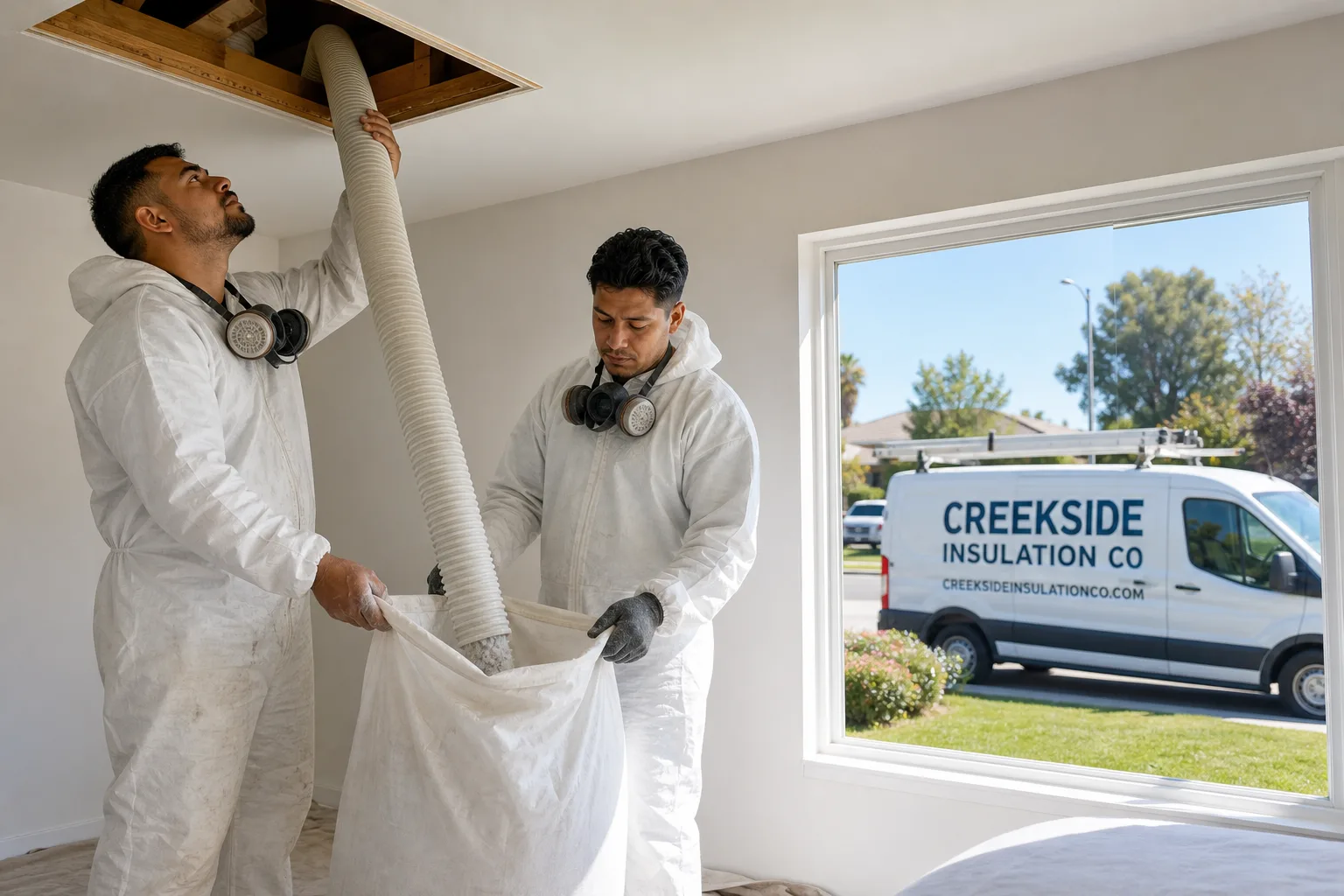
Fast, Reliable Spray Foam Insulation Across San Joaquin Hills
Spray foam insulation in San Joaquin Hills typically runs $2.50 to $6.50 per board foot installed, with most whole-attic projects landing between $4,800 and $14,000 depending on foam type and roofline complexity. We’re Creekside Insulation Co, and we’ve spent years inside the attics and crawlspaces of this community, learning exactly how the marine layer and inland heat cycle punish insulation that wasn’t specified for both. If your rooms run hot upstairs, your AC can’t keep up in August, or you hear the 73 toll road hum from inside your bedroom, call (844) 948-3251 and we’ll come take a proper look.
Why Creekside Insulation Co Is San Joaquin Hills’s Preferred Spray Foam Insulation Company
San Joaquin Hills isn’t Irvine. The tract uniformity you see across the 405 doesn’t exist up here. Homes off Ridge Park Road, along Newport Coast Drive, and through the canyon-adjacent streets of the 92657 zip are custom or semi-custom, with tile roofs, stucco exteriors, vaulted ceilings, and multi-zone systems that demand a whole different level of insulation detailing. Our crews know these rooflines because we’ve worked them. Noel Ibarra, who runs our operation, has made it a point to train every installer on the specific failure points we find in this community: eave-line transitions on cathedral ceilings, HVAC chases that puncture the thermal boundary, and gable vents that act like ember invitations during Santa Ana winds.
We don’t push one foam and call it a day. We carry both Icynene and Demilec spray foam lines, open-cell and closed-cell, because the right answer on a canyon-edge custom home isn’t the same as the right answer on a 1980s Mediterranean off San Joaquin Hills Road. That product breadth means our recommendation to you is based on your house, not our inventory. And we answer the phone when San Joaquin Hills homeowners call, usually arriving for estimates within a day or two.
Does Open-Cell Spray Foam Work in San Joaquin Hills?
Yes, open-cell spray foam works in San Joaquin Hills homes, but only when the installation accounts for the fog-condensation cycle this specific geography creates. Open-cell foam is vapor-permeable, which is normally a benefit. It lets moisture move through rather than trapping it. But in San Joaquin Hills, the marine layer rolls up the canyons almost every summer morning, pushing damp air under tile roofs and against the underside of roof decks. When that moisture meets a cool attic surface, it condenses. If open-cell foam is installed right to the deck without attention to eave-line airflow, that condensation can wick into the foam’s open cell structure. Over years, the foam saturates, sags, and separates, leaving gaps that defeat the whole point of the air seal.
This isn’t theoretical. We’ve pulled open-cell foam out of San Joaquin Hills attics where the lower three feet had turned dark and heavy with absorbed fog moisture. The fix is specification, not avoidance. We use open-cell in wall cavities and some attics where the ventilation design supports it, and we switch to closed-cell at the eave transitions and thermal bridges where fog-driven wetting concentrates. That’s the material matching our company exists to do.
For attics that hold excessive heat, open-cell can still work as a ventilated assembly or hybrid system. For cathedral ceilings with no vent space, closed-cell is almost always the better call here. But every home gets its own assessment, not a script.
Where open-cell fits best
Interior wall cavities on 1980s and 1990s San Joaquin Hills homes are good open-cell candidates. The foam fills odd framing, kills drafts through electrical penetrations, and adds acoustic separation between rooms and from canyon wind noise. We also use it in vented attics where airflow is confirmed and eave details are correct.
Spray Foam Insulation Contractors in San Joaquin Hills
Choosing a spray foam insulation contractor in San Joaquin Hills means finding someone who understands that this community’s housing stock wasn’t built with insulation performance as the top priority. These were 1980s and 1990s custom builds, often gorgeous, with complex rooflines, multi-level living spaces, and large glass facing the canyon views. The glazing lets in heat. The tile roofs hold heat. The attic temperatures climb past 150°F on inland summer days while coastal fog keeps the exterior surfaces cool and damp. That temperature and moisture differential is what separates skilled spray foam contractors from crews that just show up with a rig and a hose.
When you hire Creekside, you get an installer with Icynene and Demilec authorization. That means we’ve been through the manufacturer training, not just the distributor’s sales deck. We know the expansion rates, the substrate prep requirements, the ambient temperature windows, and the cure times for each specific formulation. On a San Joaquin Hills jobsite where the fog hasn’t burned off by 9 a.m., knowing when and how to apply the foam is the difference between adhesion and failure.
How we detail complex rooflines
Custom homes with turrets, dormers, tray ceilings, and multi-zone HVAC chases need spray foam installed as a continuous air barrier, not a sprayed-afterthought. We map the thermal boundary before we ever mix a barrel of foam. Every chase that carries ductwork or plumbing from a hot attic into living space gets sealed. Every eave-to-deck transition gets looked at for condensation risk. That’s the work that keeps conditioned air where you paid to put it.
Attic venting and ember protection
On canyon-edge properties in San Joaquin Hills, we also address the ember problem. Santa Ana events push wind-driven embers into gable vents and attic openings. If those embers reach exposed foam or the framing around it, you have a fire path. We install fine-mesh ember screens on gable and eave vents and specify foam placement that keeps combustible buildup away from ignition points. Most coastal cities don’t deal with this. Here, it’s part of doing the job right.
Trusted Brands We Service in San Joaquin Hills
We’re authorized to install Icynene and Demilec spray foam, and that matters to San Joaquin Hills homeowners who want manufacturer-backed formulations, not off-brand mystery barrels. Beyond foam, our full lineup includes Owens Corning, Johns Manville, Knauf, and GreenFiber so if we find during the assessment that spray foam isn’t the right tool for a particular condition, we have honest alternatives to offer. That’s the whole point of carrying eight brands. You get the recommendation your home actually needs. Spray Foam Insulation isn’t a commodity product here; it’s a specification decision.
Common Spray Foam Insulation Problems We See in San Joaquin Hills Homes
- Fog-wet open-cell foam at eave transitions. Marine layer moisture condenses on the cool underside of tile roofs, and open-cell foam at cathedral ceiling eaves absorbs it. Over several seasons, the foam darkens, sags, and pulls away, creating a cold wet channel where the thermal seal is broken.
- Foam shrinkage around HVAC penetrations. Multi-zone systems in custom San Joaquin Hills homes mean dozens of duct runs, linesets, and wiring chases punching through the thermal boundary. If the foam isn’t properly bonded at each penetration, 150°F attic air bleeds into conditioned space and your AC runs constantly.
- Santa Ana ember paths into foam-adjacent cavities. Gable vents and unscreened attic openings on canyon-edge homes can draw wind-driven embers during fall Santa Ana events. Foam and fiberglass around those openings become fuel. This risk barely exists in beachfront Newport Beach or flat Irvine.
- Noise transfer through thin wall and ceiling assemblies. Homes backing up to the 73 or exposed to canyon wind see sound transmission through framing and recessed can lights. Open-cell foam in the right cavities cuts that dramatically, but only if the installer knows where the noise enters.
Pricing for Spray Foam Insulation in San Joaquin Hills, CA
Open-cell spray foam in San Joaquin Hills runs $2.50 to $4.25 per board foot installed. Closed-cell runs $4.00 to $6.50 per board foot. A typical attic retrofit on a 3,000-square-foot home lands between $6,000 and $14,000 depending on foam type, access difficulty, and whether we’re doing rim joists, garage ceilings, or roof decks. Rim joist sealing alone in this area often runs $1,500 to $3,500. Garage ceiling spray foam on a standard three-car garage runs $2,000 to $4,500. These are representative ranges based on work we’ve done throughout the 92657 zip. Your exact number comes from a free on-site assessment. Call (844) 948-3251 and we’ll walk the house with you, quote it straight, and leave you with a written number.
We Also Serve Cities Near San Joaquin Hills
Creekside Insulation Co works throughout San Joaquin Hills and surrounding communities including Aliso Viejo, Newport Beach, Laguna Beach, and Irvine. If you’re a few minutes down Newport Coast Drive or up in Laguna Canyon, the same crew, the same brands, and the same honest recommendation process apply.
Serving San Joaquin Hills, CA — Our Local Coverage Area
We’re based in the San Joaquin Hills area and know this community well. Use the map below to see our service coverage — if you’re nearby, we can almost certainly help.
FAQs About Spray Foam Insulation in San Joaquin Hills
Open-cell works when specified for the fog side of the equation. The marine layer that rolls through San Joaquin Hills canyons creates condensation at eave lines and cool roof decks. Open-cell foam absorbs that moisture if installed without proper detailing. We specify open-cell for wall cavities and properly vented attics, and closed-cell for cathedral ceilings, eave transitions, and any surface exposed to frequent condensation. Call (844) 948-3251 and we’ll tell you which parts of your home need which foam.
Santa Ana wind-driven embers enter attics through gable and eave vents. Canyon-edge homes in San Joaquin Hills sit directly in those wind paths. Embers landing near exposed spray foam or framing ignite quickly. We install fine-mesh ember screens at vent openings and keep foam clear of potential ignition points. It’s a detail most insulation crews skip because most don’t work in wind-prone canyon communities.
Yes, and those conditions are exactly where spray foam earns its cost. Custom rooflines create dozens of thermal bridges and hard-to-reach cavities that batts and blown-in can’t seal. Multi-zone HVAC means multiple chases and penetrations digging through the insulation boundary. Spray foam fills the irregular spaces and seals the chases. But it has to be detailed correctly at every transition or you’ll have hot spots. We map the whole boundary before spraying.
Open-cell spray foam absorbs sound energy that passes through framing, can lights, and wall cavities. At 1.5 to 2 inches thick, it dampens the mid-frequency noise from the 73 toll road and the low rumble of canyon wind against the roofline. Homes off Newport Coast Drive and along the canyon edges notice the difference in upstairs bedrooms and bonus rooms, which are typically the loudest spaces.
Every three to five years, or sooner if you notice musty odors, visible sagging at ceiling lines, or a sudden spike in cooling costs. Fog-driven condensation damage doesn’t announce itself loudly. What we found on that canyon-edge custom off Ridge Park Road, where open-cell foam had pulled away and left a wet channel under the eaves, had been developing for years before the homeowner felt the upstairs room getting hotter and damper. Early inspection catches that before it becomes a tear-out.
If you’re in San Joaquin Hills and you want a straight answer about what your attic actually needs, call Creekside Insulation Co at (844) 948-3251. We’ll come out, look hard at the details, and give you a written recommendation with real numbers. Free estimate, no pressure, just the facts about your home.
Written by Noel Ibarra, Owner at Creekside Insulation Co, serving San Joaquin Hills and surrounding communities.