
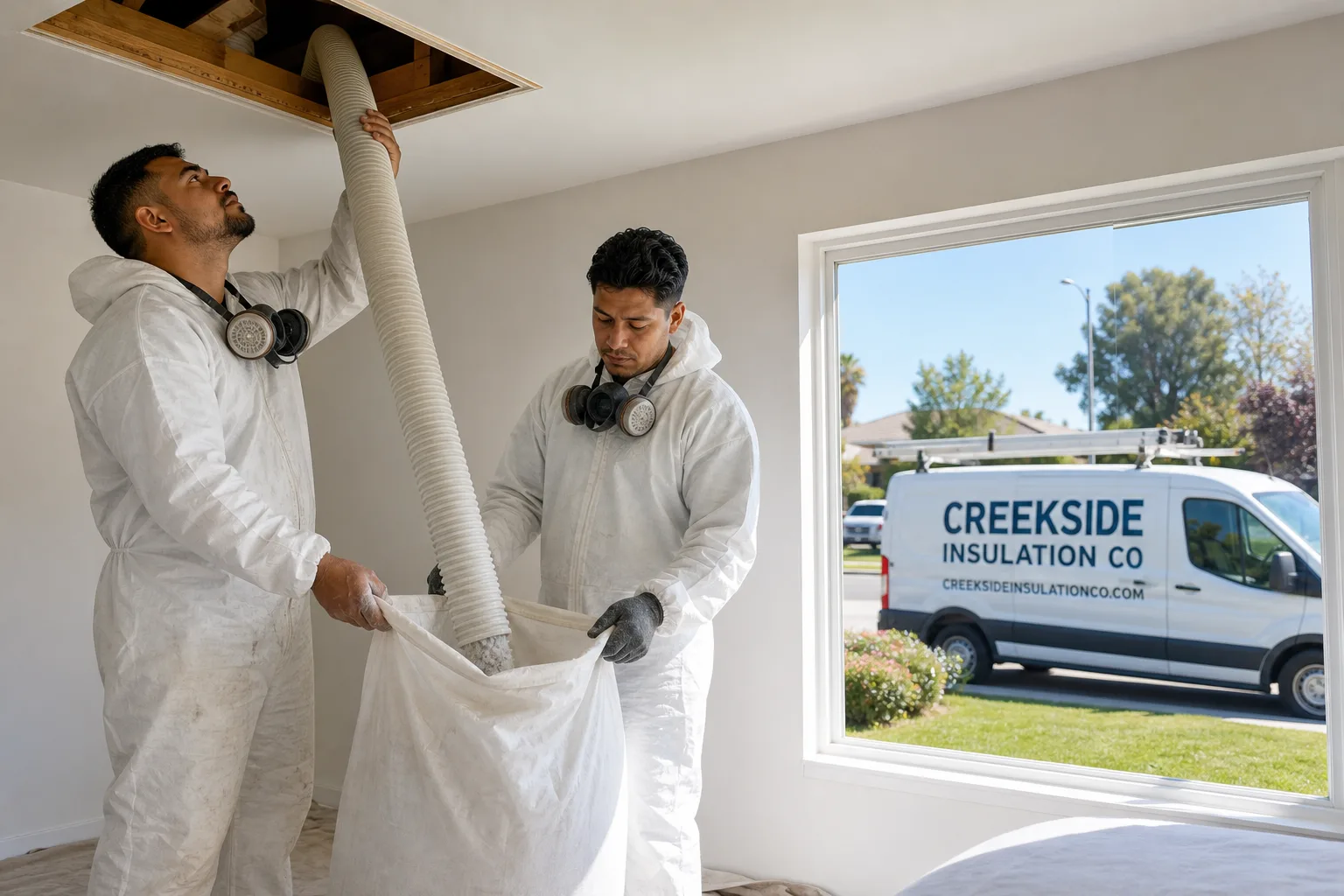
Fast, Reliable Spray Foam Insulation Across Portola Hills
Spray foam insulation in Portola Hills addresses a specific problem: shallow, low-pitch attics that bake under inland sun and let conditioned air escape through dozens of small gaps. Most homes here were built in the 1980s and 1990s with R-11 to R-19 fiberglass batts that have since compressed, shifted, or been disturbed by trades work. We replace that underperforming layer with open-cell and closed-cell foam sealed directly to the roof deck and top plate. Call (844) 948-3251 and we can have a crew at your Portola Hills home within days, not weeks.
Why Creekside Insulation Co Is Portola Hills’s Preferred Spray Foam Insulation Company
We know Portola Hills attics differently than a crew coming up from the coast. The hillside lots off Saddleback Ranch Road and Glenn Ranch Road put afternoon sun directly on west-facing roof planes, and the low-pitch concrete tile means the attic cavity is tight. Shallow spaces like that change how foam gets applied. Our Spray Foam Insulation team has spent enough time in Portola Hills tract framing to know exactly where the top plate gaps, soffit vent issues, and compressed batts show up before we even open the hatch.
We carry eight insulation product lines across four material types, which means when we recommend Icynene open-cell for a 2×4 rafter bay or Demilec closed-cell for a rim joist, that recommendation isn’t driven by what we happen to stock. It’s driven by what your Portola Hills home actually needs. We work throughout 92610 and the surrounding Saddleback Valley communities, and our pricing is set for this market, not inflated because of a long drive.
Noel Ibarra leads Creekside Insulation Co, and the standard he holds is simple: leave every attic sealed tighter and performing measurably better than when we arrived.
Open Cell Spray Foam in Portola Hills
Open Cell Spray Foam in Portola Hills is the workhorse upgrade for those shallow 1980s and 1990s tract attics. Because the rafter bays here are often nominal 2×4, not the 2×6 or 2×8 you see in newer builds, hitting target depth requires experience. We apply open-cell in two passes, letting the first pass expand and cure before the second goes on. That prevents the foam from bulging the drywall below while still reaching full depth in the bay. A typical open-cell roof deck application in Portola Hills runs $3,200 to $7,800 depending on square footage and access.
Two-Pass Application for Shallow Bays
The ridge and rafter bays in Portola Hills tract homes are often too thin for a single-pass open-cell lift. If a crew tries to do it in one pass, the foam either bulges through the drywall or under-fills and leaves voids at the top plate. We don’t do that here. Our crew knows the framing profile before we start and we schedule curing time between passes.
When to Choose Open-Cell Over Closed-Cell
For Portola Hills attics that are vented and dry, open-cell is often the right call. It air-seals the roofline, costs less per board foot than closed-cell, and the second-pass technique gets full depth even in 2×4 bays. Closed-cell is the better option when you need moisture control or structural rigidity, like on a garage ceiling or a rim joist. The answer depends on the home’s conditions, not on a default product push.
Spray Foam Insulation Contractors in Portola Hills
Spray Foam Insulation Contractors in Portola Hills should understand two things before they quote: the radiant-heat load coming through those tile roofs, and the Santa Ana wind paths through unsealed soffit vents. Our crews handle both. A full attic air-seal and foam application in Portola Hills typically runs $4,500 to $9,800 for a two-story tract home. Rim joist work in the garage usually lands between $900 and $2,200. We’ll give you a fixed number before any work starts.
Sealing the Top Plate and Soffit Baffles
Before foam goes in, the top plate has to be sealed and baffles installed at every soffit vent. In Portola Hills, dry Santa Ana winds push dust and embers through those vents, and an unsealed baffle gives wind a straight shot into the attic. We seal first, then foam. That order matters, and skipping it is the most common mistake we fix from other installs.
West-Facing Knee Walls and Bonus Rooms
Homes along the upper streets off Saddleback Ranch Road catch brutal afternoon sun on west-facing attic knee walls. We measure surface temps up past 150°F on those walls in summer. Foaming the knee wall and the adjacent rafter bays stops that heat from bleeding into upstairs bonus rooms. That’s the difference between a room that cycles the AC all evening and one that holds its temperature.
Trusted Brands We Service in Portola Hills
We install open-cell and closed-cell spray foam from Icynene and Demilec, two of the most proven foam brands in North America. When a Portola Hills home calls for fiberglass or mineral wool in a specific area, we carry Owens Corning, Johns Manville, Knauf, CertainTeed, and Rockwool. We also stock GreenFiber cellulose for homeowners who want a high-recycled-content option. Eight brands, one honest recommendation.
Common Spray Foam Insulation Problems We See in Portola Hills Homes
- Compressed R-11 batts under shallow tile roofs. The original fiberglass in 1980s and 1990s Portola Hills attics is often mashed down under the deck, losing most of its R-value. Spraying foam over it without removing it traps heat instead of blocking it.
- Dust and ember entry through unsealed soffit vents. Santa Ana winds drive fine dust and occasionally embers into the attic when baffles aren’t sealed before foam goes in. We see this on nearly every pre-2000 home we open up in 92610.
- Single-pass foam in 2×4 rafter bays. Thin bays need two passes to reach depth. A single-pass job leaves uninsulated gaps at the top plate or bulges the drywall. We redo more of these than we’d like to count.
- Leaky top plates around the second-story band joist. The framing junction between floors is a major air leakage point in two-story Portola Hills tract homes. Sealing that top plate before insulating is where the energy savings actually come from.
Pricing for Spray Foam Insulation in Portola Hills, CA
Here’s what Portola Hills homeowners can expect for spray foam insulation work in this market. An open-cell roof deck runs $3,200 to $7,800. A closed-cell rim joist job in the garage runs $900 to $2,200. A full attic air-seal with open-cell rafter coverage on a two-story tract home runs $4,500 to $9,800. The biggest variables are square footage, access difficulty in those shallow tile-roof attics, and whether we’re removing old batt insulation first. Every project gets a fixed quote before we start. Call (844) 948-3251 and we’ll come out, measure, and give you a number that doesn’t move.
We Also Serve Cities Near Portola Hills
Creekside Insulation Co serves homes throughout the Saddleback Valley and south Orange County. In addition to Portola Hills, we run crews to Foothill Ranch, Lake Forest, Mission Viejo, and Laguna Woods. If you’re in a neighboring community and dealing with the same shallow-attic heat gain or wind-driven dust problems, we know the housing stock and we’re already nearby.
Serving Portola Hills, CA — Our Local Coverage Area
We’re based in the Portola Hills area and know this community well. Use the map below to see our service coverage — if you’re nearby, we can almost certainly help.
FAQs About Spray Foam Insulation in Portola Hills
Spray foam air-seals the attic in a way that blown fiberglass never can. In Portola Hills, the shallow tile-roof attic deck leaves little room for adequate loose-fill depth, and the wind-driven air exchange through top plate gaps and soffit vents makes a blown product perform far below its rated R-value. Foam seals those gaps at the source. Call (844) 948-3251 for a side-by-side assessment of your attic.
No. Removing the original batts first is the correct approach. Spraying over compressed fiberglass traps heat against the drywall and creates a moisture sandwich in the rafter bay. We pull the old material out, inspect the framing and wiring, seal the top plate, and only then apply foam.
The low-pitch concrete tile roofs here create shallow rafter bays, usually 2×4 framing. That means open-cell foam has to be applied in two passes to reach the target depth without bulging the ceiling drywall. A crew without experience in this housing stock will under-fill or over-expand. We’ve corrected both.
Yes, when the soffit baffles and top plate are sealed before the foam goes in. Foam alone cannot stop wind-driven dust if the baffles are left unsealed. The combination of proper baffling, top plate sealing, and foam application is what keeps dust and embers out during wind events. Call (844) 948-3251 and we’ll inspect your soffit vents as part of the estimate.
Check that the attic access hatch or pull-down ladder is properly weatherstripped and that the garage door to the attic, if you have one, is sealed around its frame. Builder-grade doors and openers in Portola Hills tract homes often leak air through gaps that undermine the performance of a new foam installation. We can inspect and recommend fixes during your estimate.
Ready to stop losing conditioned air through your Portola Hills attic? Call Creekside Insulation Co at (844) 948-3251 today. We’ll schedule a free estimate, measure your attic, and give you a fixed price. Noel Ibarra and the crew will make sure the foam goes in right, sealed against the heat and the wind that this hillside community throws at it.
Written by Noel Ibarra, Owner at Creekside Insulation Co, serving Portola Hills and the Saddleback Valley.