
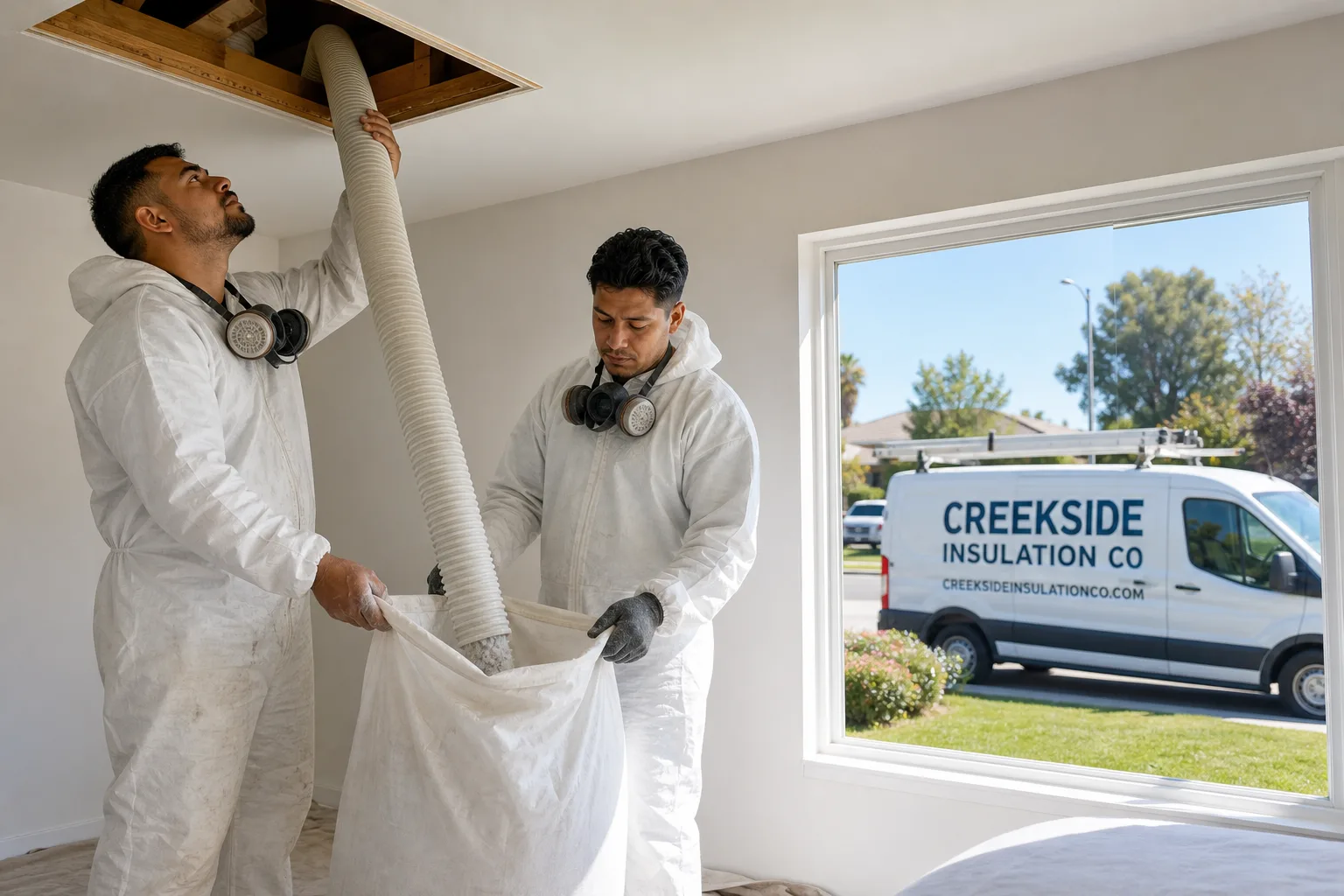
Fast, Reliable Spray Foam Insulation Across Pico Rivera
Spray foam insulation in Pico Rivera typically runs $2.50 to $6.50 per square foot installed, depending on whether you need open-cell or closed-cell foam and how much prep work your attic requires. Most Pico Rivera jobs take one to two days once we’re on site. If your 1950s or 60s tract home still has its original kraft-faced batts, you’re almost certainly losing conditioned air through your attic, and spray foam is the most effective way to stop it at the source. We work throughout 90660, 90661, and 90662, and we know exactly what these older homes need. Call (844) 948-3251 for a straight answer and a free estimate.
Why Pico Rivera Homeowners Choose Creekside Insulation Co
Noel Ibarra founded Creekside Insulation Co with a simple principle: match the material to the house, not to what’s sitting in the warehouse. That matters in Pico Rivera because so many of these postwar tract homes need a specific approach. The attics are shallow, the original insulation is shot, and in a lot of cases there’s knob-and-tube wiring that has to be dealt with before any foam goes in. We don’t skip that step, and we don’t pretend it isn’t there.
Pico Rivera homeowners call us when they’re tired of rooms that never cool down in August and utility bills that keep climbing. We carry eight brands across all four major insulation categories, including Icynene and Demilec for spray foam, so our recommendation for your home is driven by what the attic actually needs, not by what we’re trying to move off the shelf. Our Spray Foam Insulation team handles both open-cell and closed-cell applications, and we bring the same crew, same standards, and same straight talk to every job in Pico Rivera.
What Spray Foam Insulation Costs in Pico Rivera
Here are the numbers for the Pico Rivera market, based on what we see day to day across these older tract homes:
| Spray Foam Application | Typical Pico Rivera Range |
|---|---|
| Closed-cell spray foam (attic roof deck, typical 1,200 sq ft home) | $4,800 – $7,800 |
| Open-cell spray foam (attic floor or roof deck, typical 1,200 sq ft home) | $2,800 – $5,200 |
| Rim joist spray foam (perimeter sealing) | $500 – $1,500 |
| Garage ceiling spray foam (converted garage) | $900 – $2,400 |
| Spray foam roof deck (full attic encapsulation) | $6,000 – $11,000 |
These ranges include prep work, which in Pico Rivera almost always means cleaning out the old batts and air-sealing before foam goes in. Your final number depends on the attic’s square footage, how much remediation the space needs, and whether you go open-cell or closed-cell. Call (844) 948-3251 and we’ll give you a written quote after we look at the attic. Estimates are free.
Closed Cell Spray Foam Insulation in Pico Rivera
Closed Cell Spray Foam Insulation in Pico Rivera is the material we recommend most often for these 1950s and 60s homes, because it does two jobs at once: it insulates at about R-6.5 per inch and it acts as an air and moisture barrier. That matters in an inland Los Angeles basin climate where summer afternoons push into the high 90s and 100s. On a 1956 single-story stucco tract home off Rosemead Boulevard, our crew opened the attic hatch and found the original kraft-faced batts flattened to a few compacted inches, rodent nests in the corners, and knob-and-tube wiring running across the joists. Before any closed-cell foam went down, we air-sealed the top plates and penetrations and coordinated with the homeowner’s electrician to clear and reroute the old wiring, then sprayed closed-cell against the roof deck to lock out the high-90s attic heat. The homeowner later reported that the back bedrooms, previously unusable in August, were finally cooling evenly.
When Closed-Cell Makes Sense
If you’re converting a garage into living space, closed-cell is usually the right call. It seals the envelope, adds structural rigidity, and won’t absorb moisture the way open-cell or batts will. For Pico Rivera homes with low-pitch attics and no room for thick insulation, closed-cell’s high R-value per inch lets you hit code without building down your ceiling.
Moisture Control in Pico Rivera’s Climate
Because Pico Rivera sits far enough inland to miss the marine layer, the big problem is heat, not humidity. But condensation still forms at the roof deck on cool winter mornings, and closed-cell stops that before it becomes a mold issue.
Open Cell Spray Foam in Pico Rivera
Open Cell Spray Foam in Pico Rivera is the default choice when you’re insulating attic floors rather than the roofline, or when budget is the main constraint. It runs about $2.50 to $4.00 per square foot installed, expands to fill wall and ceiling cavities completely, and delivers roughly R-3.5 to R-3.7 per inch. It’s not a moisture barrier, which is fine for attic floor applications where you want the roof assembly to breathe. For Pico Rivera homeowners who want to stop heat radiating from the attic into the living space without going full encapsulation, open-cell is an honest, practical solution.
Sound Control Benefits
An underappreciated feature of open-cell foam in Pico Rivera is how well it kills noise. If your home sits near Washington Boulevard or close to the 605, open-cell in the walls or attic floor noticeably cuts road noise. It also helps in homes with room additions where the bedroom is adjacent to a converted garage or a home office.
When Open-Cell Makes Sense
If the attic is only for storage and you have no HVAC ductwork up there, open-cell on the attic floor is often the best value in Pico Rivera. It seals the top plates, which is where these old tract homes leak most of their conditioned air, without the higher cost of closed-cell.
Trusted Brands We Service in Pico Rivera
Creekside Insulation Co installs products from eight manufacturers, which means we’re not locked into a single brand’s spec sheet. For spray foam in Pico Rivera, we work with Icynene and Demilec for both open-cell and closed-cell applications. We also carry Owens Corning, Johns Manville, Rockwool, and GreenFiber for the homes where foam isn’t the right fit. If the right answer for your 90661 home is blown-in cellulose instead of spray foam, we’ll tell you that. We’re not here to sell foam. We’re here to fix the comfort problem in your Pico Rivera house.
Common Spray Foam Insulation Problems We See in Pico Rivera Homes
- Collapsed 1950s kraft-faced batts. Original batts in these tract homes have compacted to a fraction of their rated R-value, often contaminated with rodent nesting debris. Spray foam over the top would just entomb the problem, so we remove and clean first.
- Unsealed top plates in shallow-pitch attics. The open-eave, low-pitch attic design in Pico Rivera’s postwar stock never sealed the top plates. That’s why hot attic air pours into the living space no matter how much loose-fill gets added later. Sealing comes before spraying.
- Knob-and-tube wiring near old insulation. Pre-1960s homes in 90660 and 90662 sometimes still have active knob-and-tube. You cannot spray foam over it safely; the foam traps heat and creates a fire hazard. We coordinate wiring remediation before we spray.
- Converted garages and room additions with irregular envelopes. Many Pico Rivera homes have been expanded over the decades, which creates oddly shaped cavities, dead air spaces, and gaps at the junction of old and new construction. Spray foam is uniquely suited to sealing these irregular spaces, but it takes careful evaluation first.
Pricing for Spray Foam Insulation in Pico Rivera, CA
Spray foam insulation in Pico Rivera costs more per square foot than batt or blown-in insulation, full stop. You’re paying for the material’s air-sealing capability, its higher R-value per inch, and the equipment and expertise required to install it correctly. In Pico Rivera specifically, there’s often a remediation cost baked in because these older tract attics need debris removal, air sealing, and sometimes wiring coordination before foam can go in. A straightforward closed-cell roof deck application on a 1,200 square foot Pico Rivera home typically lands between $4,800 and $7,800. An open-cell attic floor job runs $2,800 to $5,200. If you’re doing a converted garage or a room addition, expect to be at the lower end of those ranges because the space is smaller but irregular. Call (844) 948-3251 for a written assessment and an honest number.
We Also Serve Cities Near Pico Rivera
Creekside Insulation Co runs crews into West Whittier-Los Nietos, Montebello, Santa Fe Springs, and Bell Gardens the same way we serve Pico Rivera. If you’re in one of those areas and dealing with an older attic that won’t hold temperature, call (844) 948-3251 and we’ll schedule a look. You get the same eight-brand approach and the same honest material matching.
Serving Pico Rivera, CA — Our Local Coverage Area
We’re based in the Pico Rivera area and know this community well. Use the map below to see our service coverage — if you’re nearby, we can almost certainly help.
FAQs About Spray Foam Insulation in Pico Rivera
Because Pico Rivera’s 1950s-70s tract homes almost never have attics that are ready for foam. The original kraft-faced batts are typically collapsed, rodent-contaminated, or both, and they have to be removed before anything else happens. Many homes also still have knob-and-tube wiring that must be cleared or rerouted by an electrician before foam can legally and safely be sprayed. Those prep steps add labor cost that a newer Inland Empire home wouldn’t have. Call (844) 948-3251 for a free attic assessment and we’ll show you exactly where the money goes.
No, and in Pico Rivera we’d strongly advise against even considering it. The original batts in these homes are almost always compacted, dust-saturated, and often contaminated with rodent droppings or nesting material. Spraying foam over them seals in the contamination, prevents the attic from drying properly, and can trap heat against old wiring. Removal and cleaning comes first. Call (844) 948-3251 and we’ll tell you what condition your existing insulation is actually in.
Closed-cell is the better performer in a Pico Rivera attic that hits 100°F, because it insulates at roughly twice the R-value per inch of open-cell and acts as an air and moisture barrier. For a 1,200 square foot home with HVAC ducts in the attic, closed-cell against the roof deck keeps the entire attic space cooler. Open-cell works if you’re sealing the attic floor only and don’t need the vapor barrier. During an assessment for your Pico Rivera home, Noel Ibarra will walk you through which option fits your attic’s actual conditions and your budget.
Yes, and this is one of the situations where spray foam in Pico Rivera really earns its cost. Converted garages and room additions create irregular cavities, mismatched framing, and dead air spaces that batts and loose-fill simply cannot seal properly. Spray foam expands to fill every odd-shaped void and seals the junctions between old and new construction. We’ve done this type of work throughout 90660, 90661, and 90662, and the difference in room comfort after the envelope is sealed is immediate. Call (844) 948-3251 for a look.
If your Pico Rivera home is a 1950s or 60s single-story with the original batts still in place, adding more batts on top is usually a waste of money. The air leaks at the top plates and attic penetrations will still pull hot attic air into the living space, and the old batts underneath continue to perform at a fraction of their original rating. Spray foam, installed after proper air-sealing and remediation, addresses the actual problem rather than piling insulation on top of it. You’ll notice the difference in rooms that currently run 10 to 15 degrees hotter than the rest of the house. Call (844) 948-3251 and we’ll give you an honest recommendation, even if it turns out foam isn’t the right fit.
Ready to fix the comfort problem in your Pico Rivera home? Call Creekside Insulation Co at (844) 948-3251 for a free estimate. We’ll inspect the attic, show you what’s actually going on up there, and give you a written quote with no pressure and no one-size-fits-all pitch.
Written by Noel Ibarra, Owner at Creekside Insulation Co, serving Pico Rivera and surrounding communities.