
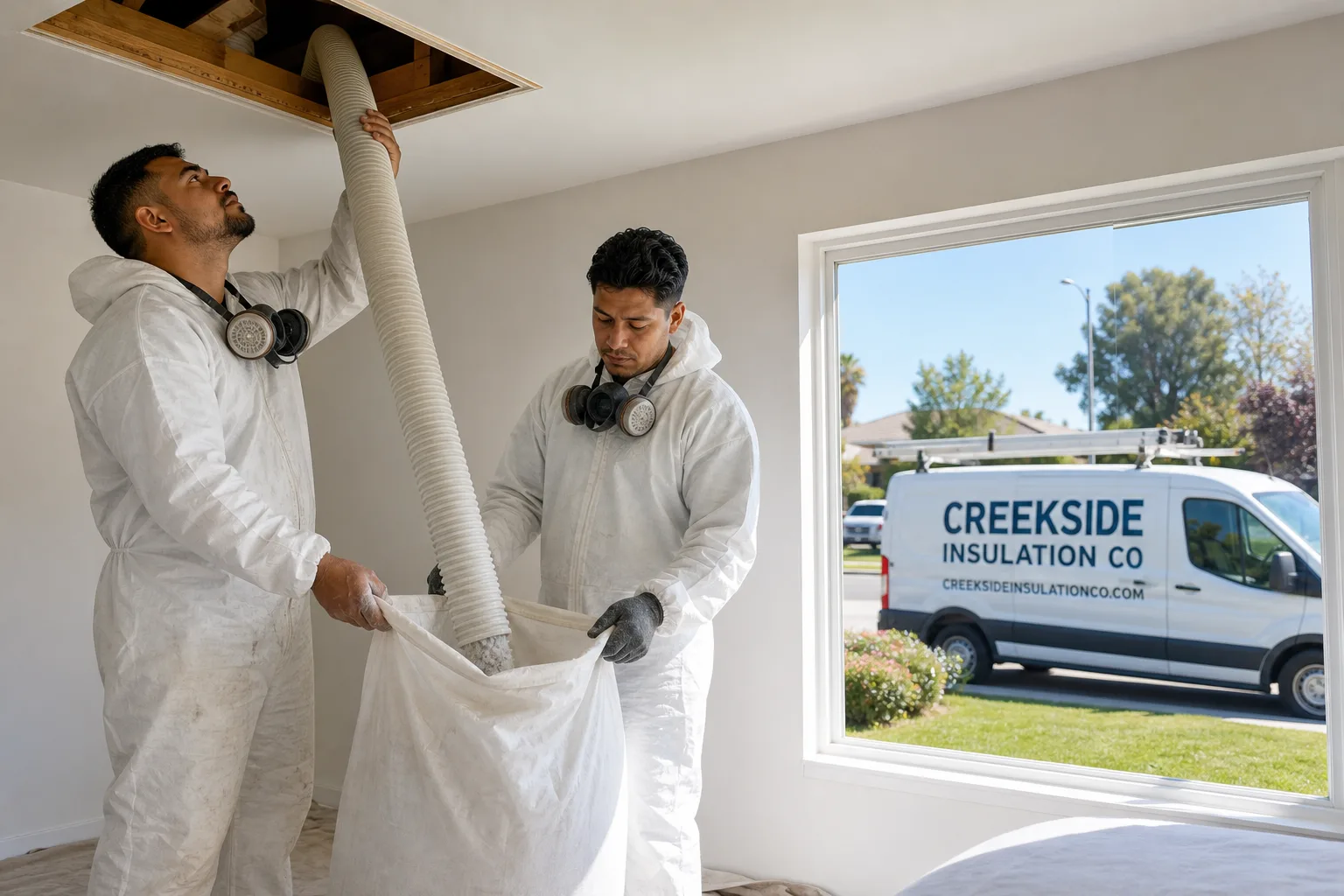
Fast, Reliable Spray Foam Insulation Across Fountain Valley
Spray foam insulation in Fountain Valley typically runs $2,100 – $5,800 depending on whether you’re sealing a rim joist, insulating a crawl space, or foaming an entire attic roof deck. Most jobs we schedule in Fountain Valley are completed within one to two days, and we respond to callouts across 92708 and 92728 the same week you call. Creekside Insulation Co has worked inside enough Fountain Valley attics to know what your tract home needs before we even open the hatch. Call (844) 948-3251 for a free estimate.
Why Creekside Insulation Co Is Fountain Valley’s Preferred Spray Foam Insulation Company
Fountain Valley homeowners keep calling us back because we treat their 1960s and 1970s tract homes as what they are: specific buildings with specific moisture and ventilation challenges, not generic square footage. Our team knows the difference between a home near Mile Square Park with original R-11 batts and a 1980s two-story off Slater Avenue that’s never had its rim joists touched. That local familiarity means fewer surprises once we’re inside. Noel Ibarra built Creekside Insulation Co around one principle: match the material to the house, not the house to whatever’s on the truck. We carry eight brand lines including Owens Corning, Knauf, and Rockwool, so when we recommend Icynene closed-cell for a damp Fountain Valley crawl space or Demilec open-cell for a low-pitch roof deck, it’s because that’s the right product for the job. Call us at (844) 948-3251 and we’ll schedule your inspection.
What you also get: one crew that handles Spray Foam Insulation, attic work, and blown-in cellulose so you’re not juggling subcontractors. And if you’ve been researching options, you’ve likely noticed most insulation companies in the area push one or two brands. We don’t. Eight brands, one honest recommendation.
Rim Joist Spray Foam in Fountain Valley
Rim joist spray foam in Fountain Valley costs between $1,400 and $2,900 for a typical single-story home, depending on linear footage and how much air-sealing is needed first. The rim joist is the wooden band where your foundation meets your floor framing, and in Fountain Valley’s coastal air, this is where humid outdoor air sneaks into your home year-round. In the older tracts near Mile Square Park, we routinely find rim joists with gaps around electrical penetrations and plumbing chases that were never sealed when the home was built. Foam here stops stack-effect airflow at its entry point: the bottom of the house.
Air-Sealing Before the Foam
Older Fountain Valley homes almost always need prep work before foam touches the rim joist. Rodent-chewed gaps, loose electrical boxes, and decades-old caulk that’s turned brittle let the marine layer work its way into wall cavities. We seal those pathways first, then apply closed-cell foam to lock the sill plate and rim board together. Skipping this step in a 1968 tract home near Fountain Valley means the foam goes in, but the drafts keep coming.
What Closed-Cell Does That Open-Cell Won’t
We use a closed-cell formulation for most Fountain Valley rim joist jobs because it acts as a vapor barrier as well as an air barrier. That matters close to the coast, where morning humidity presses against your foundation all spring and early summer. Closed-cell foam also stiffens the rim assembly, which older wood-frame tract homes appreciate.
Crawl Space Spray Foam Insulation in Fountain Valley
Crawl space spray foam insulation in Fountain Valley ranges from $1,800 to $4,200 for a full encapsulation-grade application on a standard 1,200 to 1,800 square foot home. Homes in Fountain Valley with vented crawl spaces pull marine moisture under the house every night, and that damp air rises into the living space. We recently foamed the rim joists and crawl space of a 1968 single-story tract home near Mile Square Park where decades of rodent activity had left gaps around electrical penetrations. We air-sealed those first, then applied Icynene closed-cell foam to the rim joist and Demilec to the crawl space walls, which stopped the persistent musty odor and stabilized attic humidity. That’s what a real moisture-smart approach looks like here.
Crawl Space Walls vs. Crawl Space Ceiling
Most Fountain Valley homeowners don’t realize that insulating the crawl space ceiling traps moisture against the floor joists. We recommend insulating the crawl space walls instead, with attention to the rim joist band. This puts the thermal boundary at the outside of the space and lets the crawl area become part of the conditioned envelope. For a crawl space that already smells musty, this is the only approach we recommend.
When Rodent Activity Is the Root Cause
Older Fountain Valley tracts have mature landscaping and plenty of roof rats, which means crawl spaces often show signs of years of nesting and chewing. Foam can’t fix a rodent superhighway. We inspect, identify entry points, and seal those before foam goes in. If the space isn’t sealed against pests, you’re just insulating a habitat.
Trusted Brands We Service in Fountain Valley
We install and service spray foam from Icynene and Demilec, two of North America’s most tested foam manufacturers, and we pair that with fiberglass options from Owens Corning, Johns Manville, and Knauf when a home calls for a hybrid approach. Having these lines on the truck means we don’t have to steer a Fountain Valley homeowner toward a product that’s wrong for their roof pitch or crawl space just because it’s what we stock. Rockwool rounds out the range for homes needing fire-rated or sound-deadening assemblies near attached garages and shared walls. We keep common materials staged locally so Fountain Valley jobs don’t stall waiting on a distributor.
Common Spray Foam Insulation Problems We See in Fountain Valley Homes
- Marine-layer moisture trapped against low-pitch roof decks. Fountain Valley’s morning marine layer keeps attic dew points high, and when foam is applied too thickly to a low-pitch roof deck without ventilation planning, it can delaminate or grow surface mold. We control thickness and material choice for exactly this condition.
- Rodent-chewed bypasses that nullify the foam. In the older neighborhoods around Mile Square Park and along Bushard Street, we often find plumbing and wiring penetrations gnawed wide open. Humid air pours through these gaps even after foam is applied elsewhere, which is why we air-seal first, every time.
- Settled original insulation mixed with new foam. Many Fountain Valley homes built between 1959 and 1980 still have their original fiberglass batts, now compacted to a fraction of their rated R-value. Spraying foam over the top without removing the old material creates uneven thermal barriers and can trap moisture in pockets.
- Attached garages with uninsulated shared walls. Fountain Valley’s tract layout puts the garage against the living space in most homes. Foam on the garage ceiling and shared wall stops hot air from the garage pressing into the house, but only when the rim and band joists are sealed too. Partial jobs don’t deliver partial comfort; they deliver the same complaints.
Pricing for Spray Foam Insulation in Fountain Valley, CA
You should expect to pay real money for real sealing, and Fountain Valley pricing reflects that. Rim joist work runs $1,400 – $2,900. Crawl space applications run $1,800 – $4,200. Full attic roof deck foaming on a typical Fountain Valley tract home runs $3,200 – $5,800, with the lower end for open-cell over a vented attic and the upper end for closed-cell on the underside of a low-pitch roof deck. What moves the number: square footage, how much air-sealing prep we uncover, and whether old insulation needs removal before foam goes in. We price upfront after a site inspection. Call (844) 948-3251 for a free estimate, and we’ll walk your attic and crawl space with you before quoting.
We Also Serve Cities Near Fountain Valley
Our installers cover the surrounding Orange County area from our base in Midway City, which puts us about 10 minutes from most Fountain Valley neighborhoods. We regularly work in Fountain Valley, Midway City, Huntington Beach, Costa Mesa, and Westminster. If you’re a few blocks outside Fountain Valley proper, call anyway; we’re likely already working your street.
Serving Fountain Valley, CA — Our Local Coverage Area
We’re based in the Fountain Valley area and know this community well. Use the map below to see our service coverage — if you’re nearby, we can almost certainly help.
FAQs About Spray Foam Insulation in Fountain Valley
Yes. Fountain Valley’s marine layer holds attic dew points high for most of the year, and low-pitch roof decks collect that moisture like a lid on a pot. We recommend closed-cell or vapor-permeable open-cell formulations depending on your roof pitch and ventilation setup, and we lean on Icynene and Demilec because their technical data gives us the thickness and perm-rating control this climate demands. Call (844) 948-3251 and we’ll tell you exactly which product fits your house after we inspect it.
Because in tracts built in the 1960s and 1970s, the bypasses around plumbing, wiring, and ducts are often larger than the leaks in the building envelope itself. Foam can’t perform if humid air flows around it through rodent-chewed gaps and open chases. We seal every penetration first, then foam. Skipping air-sealing in one of these homes is like caulking a window with the sash open.
Yes, when the foam is applied to the crawl space walls and rim joist after the entry points are sealed. We use closed-cell foam for this application because it blocks both air and vapor. The musty smell in Fountain Valley crawl spaces is almost always fungal activity feeding on damp wood and debris; once we isolate the space from the marine air and remove the moisture source, the smell does not come back.
It changes the material call. Low-pitch roof decks have less air space between the deck and the ceiling, so moisture that gets trapped against the wood has nowhere to dry. We apply foam in thinner, carefully controlled passes and prefer formulations that let the assembly dry to the attic side when ventilation is present. A thicker coat is not better here; it’s a mold risk.
Usually yes, and especially in older tract homes where the original fiberglass has settled, compacted, or been contaminated by rodents. Spraying foam over settled, dusty, or contaminated insulation creates an uneven thermal barrier and can trap moisture. We remove the old material, inspect the deck and framing, air-seal, and then apply foam to a clean substrate. The only exception is when the existing insulation is clean, dry, and performing; we’ll tell you honestly either way.
Get Your Fountain Valley Spray Foam Estimate Today
If you live in Fountain Valley and your attic or crawl space has been fighting the marine layer all year, call us. We’ll inspect your home, explain what we found in plain terms, and quote you a number that reflects the job your house actually needs. Reach Creekside Insulation Co at (844) 948-3251 for your free estimate.
Written by Noel Ibarra, Owner at Creekside Insulation Co, serving Fountain Valley spray foam and insulation needs.