How to Choose the Right Insulation Company in Midway City
Choosing the right insulation company comes down to one test: can the contractor explain, in plain language, why they’re recommending a specific material for your specific attic, walls, or crawlspace? If the answer is some version of “it’s what we use” or “it’s the best” without a technical reason tied to your home’s construction, air leakage points, and climate zone, you’re not talking to an insulation specialist. You’re talking to a product salesperson. And Midway City homes, with their mix of 1950s and 1960s ranch-style construction and newer additions, need a diagnosis before a recommendation.
Why the Product-Inventory Test Matters More Than Reviews
Most homeowners start their search with online reviews. That’s reasonable, but there’s a question that matters more before you even look at star ratings: how many different insulation products does this company actually install? Because here’s what we’ve learned working in Midway City attics and crawlspaces for years: a contractor who only installs one type of fiberglass batt will recommend fiberglass batt every single time. Not because it’s wrong for your home, necessarily, but because it’s what they stock, what their crew knows, and what their pricing sheet is built around.
That’s a conflict of interest hiding in plain sight. You can detect it in five minutes with a simple test. Call the company and ask, “What insulation materials do you install?” A material-agnostic contractor will rattle off options and start asking about your home’s construction year, existing insulation depth, and comfort complaints. A locked-in contractor will give you a one-sentence answer and pivot to scheduling an estimate. Neither answer is wrong on its face, but the first one tells you the recommendation will be driven by your house, not their warehouse.
At Creekside, we install products from eight manufacturers across all four major categories: fiberglass from Owens Corning, Johns Manville, CertainTeed, and Knauf; mineral wool from Rockwool; open- and closed-cell spray foam from Icynene and Demilec; and recycled cellulose from GreenFiber. We carry that range for one reason: a 1960s Midway City rancher with a vented attic and a 2015 addition with a cathedral ceiling need completely different approaches. If we only sold one product line, we’d have to pretend otherwise.
Key Takeaway: Before you invite anyone into your attic, ask what they install and listen for how many questions they ask you in return. The questions reveal the diagnosis. The product list reveals the bias.
California Licensing: What to Verify Before You Sign Anything
In California, insulation contractors must hold a valid license issued by the Contractors State License Board (CSLB). Insulation and acoustical work falls under the C-2 insulation and acoustical classification, though some insulation work may be performed under a general building (“B”) license depending on scope. You should not take a contractor’s word for this. The CSLB maintains a public license lookup tool at cslb.ca.gov, and checking a Midway City contractor’s license takes under five minutes.
Here’s what to verify:
- License status is “active” and the classification matches the work being quoted (C-2 for insulation-specific scope).
- No active suspensions or revocations listed in the license history.
- Workers’ compensation insurance is on file if the company has employees, which it should for a full insulation crew.
- Bond status is current, which protects you if the contractor fails to complete contracted work.
Beyond licensing, ask whether the estimator or lead installer holds a BPI (Building Performance Institute) certification. BPI certification isn’t required by California law, but it indicates formal training in whole-house energy assessment: air sealing, thermal boundaries, and combustion safety. A contractor with BPI-certified staff is far more likely to measure your home’s actual conditions than one that shows up with a tape measure and a pricing pamphlet.
And one more local note: Midway City sits in climate zone 6, which means our cooling concerns outweigh heating concerns for much of the year. Insulation R-values matter, but so do air sealing and radiant barrier performance in attics that bake under Orange County sun. A licensed contractor who knows this will talk about attic ventilation and air infiltration in the same breath as R-value. A marginal one won’t mention either.
The Five Questions That Separate Diagnosticians From Tape Measurers
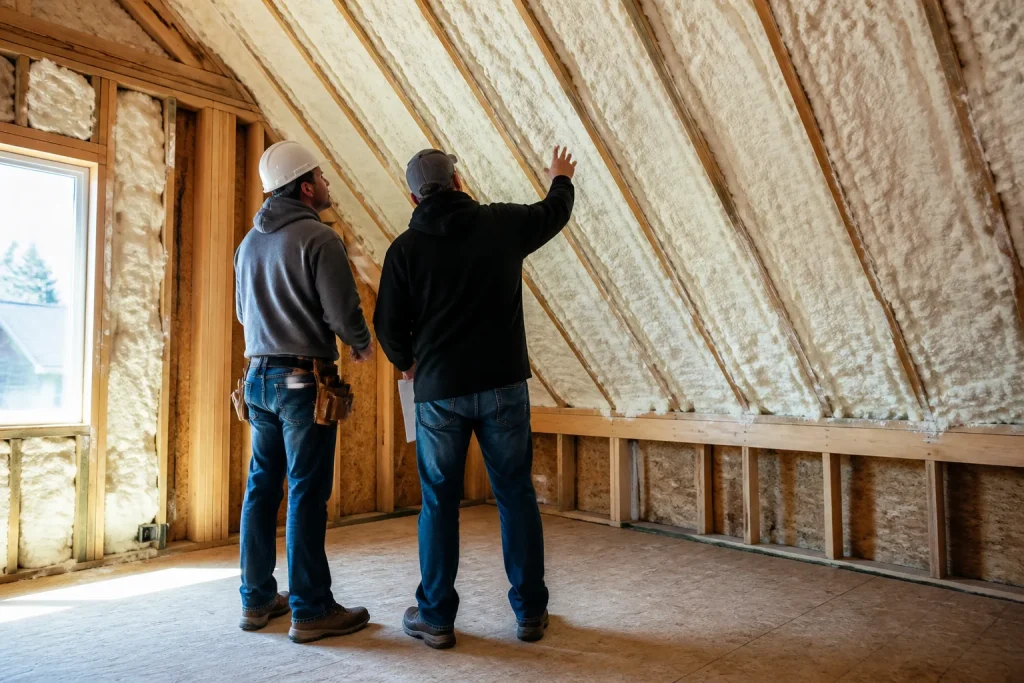
When an insulation estimator walks through your Midway City home, you can tell within ten minutes whether they’re diagnosing or just measuring. Here are the five questions a competent contractor should ask, or answer without prompting. If they don’t bring these up, you should.
- “What’s the current insulation depth and condition in your attic?” The estimator should be up in the attic with a ruler or depth gauge, not standing in the hallway with a clipboard. If they quote you without looking, that’s a red flag.
- “Have you noticed rooms that run hotter or colder than the rest of the house?” This tells them where insulation is uneven or missing entirely, which is common in Midway City homes with additions built at different times.
- “Are there signs of air leakage around the attic hatch, recessed lights, or plumbing penetrations?” Air sealing should be a standard line item for any attic insulation quote. If your estimate doesn’t mention it, you’re getting a partial fix.
- “What’s the moisture history in your crawlspace or attic?” In Midway City’s marine-adjacent climate, humidity is not a hypothetical. The right insulation choice changes if there’s condensation or past rodent activity affecting existing batts.
- “Why are you recommending this material over the alternatives?” This is the honest-answer filter. A real specialist can explain, in thirty seconds, the difference between open-cell spray foam and blown-in cellulose in your specific attic. A product pusher will repeat marketing language about “superior performance” without specifics.
Print this list or save it on your phone. Bring it to every estimate. The contractor’s body language and willingness to engage with these questions tells you more than any online review will.
Red Flags Hiding in the Estimate Document Itself
Most homeowners read the bottom-line number on an insulation estimate and skim the rest. That’s a mistake, because the estimate document is where vague contractors reveal themselves. Here’s what to look for when you get a written quote from a Midway City insulation company.
Vague scope language. “Insulate attic to R-38” without specifying depth, material type, brand, and square footage is a shortcut. A legitimate quote names the product (for example, “Johns Manville Attic Protector blown-in fiberglass at 14 inches settled depth”) and the area it covers. If the scope doesn’t match what the estimator told you verbally, ask for a rewrite before signing.
Missing air sealing line item. An attic insulation estimate that doesn’t include air sealing around the attic hatch, top plates, recessed can lights, and plumbing vents is incomplete. Blowing insulation over unsealed air leaks is like putting a thicker blanket over a hole in your wall. It doesn’t solve the problem you’re paying to fix.
Warranty language that shifts liability to you. Read the warranty section carefully. Some contracts require homeowners to maintain specific attic conditions (no roof leaks, no pest activity) for the warranty to apply, which is standard. But language that requires you to pay for labor on a defective product, or that excludes moisture-related failures entirely, is a warning sign. Competent contractors stand behind their workmanship and name the coverage period in writing.
Broad installation charges bundled into a single line. “Labor and materials: $4,800” with no breakdown tells you nothing. A detailed quote separates product cost from installation labor, which protects you if you later want to compare materials across two bids.
Local Reputation Signals That Online Reviews Don’t Capture
Online reviews are necessary but insufficient. A Midway City insulation crew can have five-star reviews from five years ago and a genuinely terrible operation today. Here are the reputation signals we tell our neighbors to look for, because they reveal how a company operates when nobody’s leaving a review.
Supplier relationships. Ask the contractor which distributors they buy from. A company that regularly purchases from the same regional insulation suppliers that serve Orange County is a going concern with established accounts. It also means they have access to current product lines, not leftover stock from a discount warehouse.
Repeat-customer rate. Insulation is usually a once-per-home job, so repeat business comes from referrals, additions, and rental property portfolios. Ask the estimator, “How much of your work comes from referrals?” A company that hesitates to answer or claims all referrals is either new or being evasive. A healthy referral rate in this industry is high because insulation work is invisible; if customers didn’t feel the difference, they wouldn’t recommend anyone.
Community presence. Does the company show up at Midway City events, sponsor local little league teams, or maintain a visible local presence beyond a map pin? We’re not saying every good contractor sponsors a team, but a company with a physical address or long-term local ties has something to protect. A contractor that only exists online or operates from a P.O. box has less riding on your satisfaction.
Willingness to show you past work. Insulation is hidden, which makes “before/after” photos rare. But a competent contractor can show you attic photos from past Midway City jobs: properly bagged and sealed insulation, labeled depth markers, air-sealed penetrations. If they have no work documentation at all, that’s a flag.
The Single Contractor Advantage
One decision many Midway City homeowners overlook is whether the company they hire for attic insulation can also handle spray foam or blown-in work on the same visit. This matters because homes are systems. If your attic needs blown-in cellulose but your cathedral ceiling needs closed-cell spray foam, hiring a crew that only does blown-in means coordinating two separate projects, two separate visits, and two separate standards.
At Creekside, our crew handles all three of the most energy-impactful insulation applications: Attic Insulation in Midway City, Spray Foam Insulation in Midway City, and Blown In Insulation in Midway City. That single-contractor model means the air sealing standard in your attic is the same standard applied to your walls or rim joists. No subcontracted second crew with different quality thresholds.
We pulled an old fiberglass batt out of a garage-over-attic conversion in western Midway City a few weeks ago where the previous crew had installed the vapor barrier facing the wrong direction. The homeowner had been living with trapped moisture for six years and had no idea. That’s not a mistake a crew that works across multiple insulation types typically makes, because they understand how vapor, air, and thermal boundaries interact. That’s the argument for a specialist, not a generalist.
When should you call a pro rather than tackle insulation yourself? Any time the work involves crawlspace access, vermiculite that may contain asbestos, or air sealing around recessed lighting and flue pipes. These conditions carry real safety and code implications, and verifying existing insulation composition is not a weekend DIY project. If you’re seeing old insulation that’s compressed, rodent-damaged, or suspicious in appearance, get an inspection before disturbing it.
The Bottom Line
Choosing an insulation company in Midway City is less about finding the highest review count and more about finding a contractor whose business model doesn’t depend on selling you one product. Verify the CSLB license. Check for BPI-certified estimators. Bring the five questions to your estimate. Read the scope language like a contract, because it is one. And if the company can’t explain why a specific material fits your specific home, keep looking.
If you want to skip the detective work, we invite you to call us for a free estimate. We’ll show you what’s in your attic, explain what it’s doing well, what it’s failing at, and which of our installed products, including Demilec spray foam, GreenFiber cellulose, or Owens Corning fiberglass, actually fits your home. You can reach us at (844) 948-3251. Or start with our Creekside Insulation Co home page to get to know our approach before we shake hands.
Frequently Asked Questions
Go to cslb.ca.gov and use the “Check a License” tool. Enter the contractor’s business name or license number, then confirm the license is active with a C-2 insulation classification (or a “B” general building classification for broader scope). Also check the workers’ comp and bond status while you’re there.
Yes, almost always. A contractor who installs products from multiple manufacturers (like Owens Corning, Johns Manville, Rockwool, and Demilec) is making recommendations based on your home’s conditions, not their inventory. Single-brand contractors carry that bias into every bid, whether it serves you or not. Call (844) 948-3251 if you want a multi-brand comparison for your Midway City home.
For climate zone 6, the U.S. Department of Energy recommends R-30 to R-60 for attics, with R-38 being the common target for existing Midway City homes. The exact right number depends on your attic’s ventilation, existing insulation depth, and whether air sealing is being done simultaneously. A contractor should calculate this for your specific attic, not quote a default number.
A full-service insulation contractor should include air sealing as part of the scope, not as an add-on from a separate trade. At Creekside, we handle air sealing around attic hatches, top plates, recessed lights, and plumbing penetrations as a standard part of our attic work. If your estimate doesn’t mention air sealing, ask why. For a thorough inspection and quote in Midway City, call (844) 948-3251.
Written by the team at Creekside Insulation Co, serving Midway City since 2016.
Need Insulation Help?
Call Creekside Insulation Co — licensed & insured, here with fast after-hours help in Midway City.
(844) 948-3251