
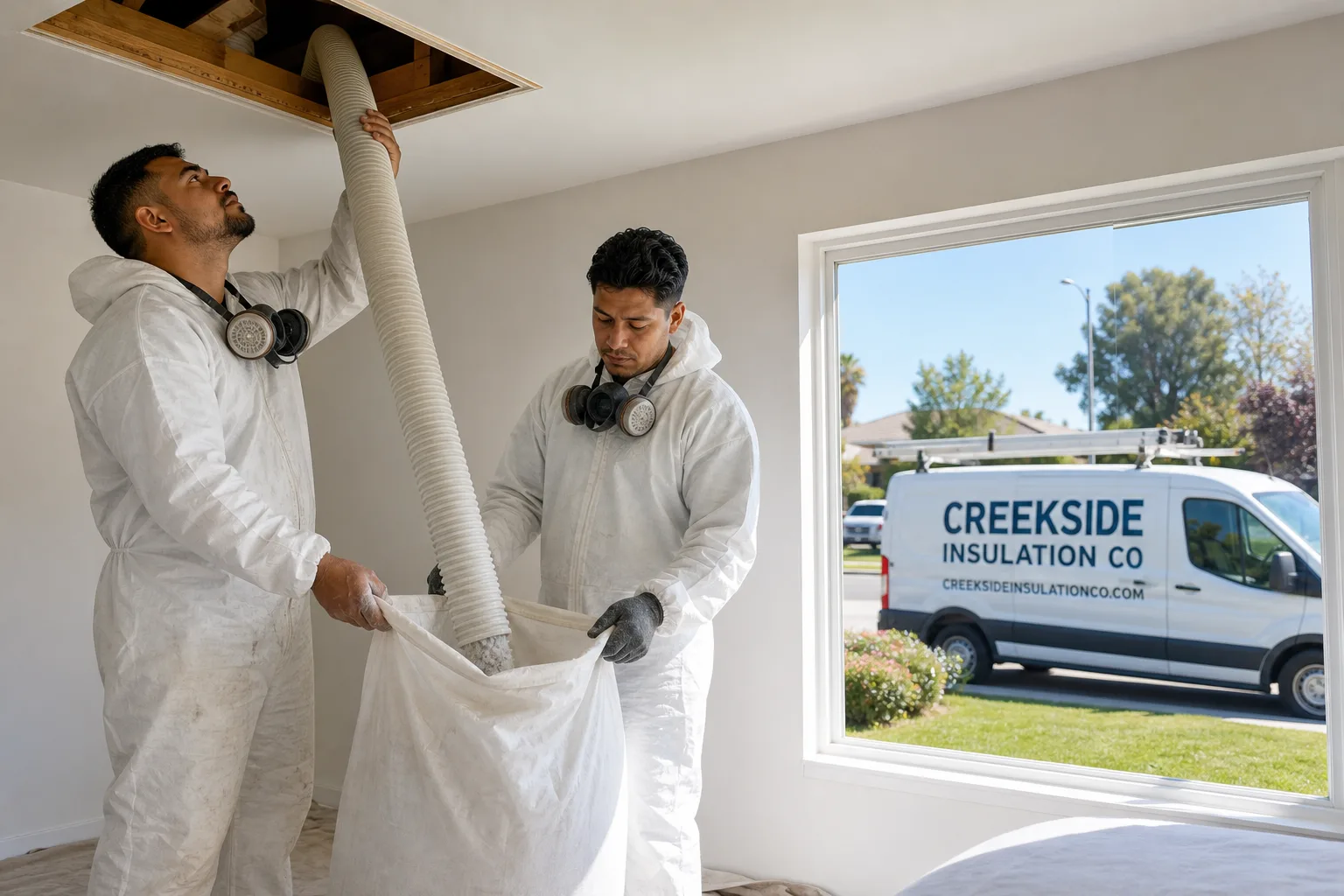
Fast, Reliable Attic Insulation Across Lomita
Attic insulation in Lomita usually runs $1,800 to $4,200 for a typical single-story postwar tract home, depending on whether we’re topping up existing material or doing a full removal and reinstall. Most jobs in the 90717 zip code are completed in half a day to a full day. If your attic still has its original 1940s – 1960s insulation or you’ve noticed that telltale musty smell when the June gloom settles in, call us at (844) 948-3251. We know these Lomita houses because we’ve worked inside hundreds of them.
Why Creekside Insulation Co Is Lomita’s Preferred Attic Insulation Company
Homeowners across Lomita keep calling us back to one thing: we don’t sell insulation by default. We diagnose first. That matters here because Lomita attics don’t fail the way attics in, say, Palmdale or Riverside fail. The marine layer does the damage down here long before thermal performance ever becomes the issue. Our team, led by Noel Ibarra, has spent years inside the compact attics off Lomita Boulevard, Narbonne Avenue, and throughout the 90717 neighborhoods between Western and Crenshaw. We know what those low-slope roofs trap, where the condensation collects, and what actually fixes it.
We’re not a general contractor dabbling in insulation on the side. Insulation is all we do, and we carry eight brands across every major material type so the recommendation comes from what your house needs. That’s the only way to be honest about it. When a Lomita homeowner calls with a soggy attic, the answer is rarely “add more fiberglass.” Usually it’s “fix the moisture path first, then insulate.” That’s the conversation most single-brand crews can’t have, because they only have one product to sell.
Attic Ventilation in Lomita
Attic Ventilation in Lomita is the single most overlooked piece of the moisture problem, and it’s the first thing we evaluate on every call in the 90717 core. Older Lomita tract homes were built with minimal soffit venting and sometimes none at all, which means the marine-layer air that creeps in through gable vents or gaps around top plates never gets pushed out. We fix this with baffled intake vents at the soffits, balanced with exhaust at or near the ridge so air moves through the attic instead of sitting in it. A typical attic ventilation upgrade in Lomita runs $600 to $1,500 depending on the roofline and how many baffles the existing framing will accept.
When a homeowner tells us their attic smells musty every morning from May through August, that’s not a mystery. That’s the June-gloom fog finding its way into a warm attic and condensing on the underside of the sheathing. Ventilation is what breaks that cycle.
Baffled Intake for Low-Slope Lomita Roofs
Most Lomita tract houses have low-slope roofs with shallow eave overhangs, which makes soffit venting a tighter job than it is on newer construction. We install rigid baffles to keep the intake path open even where insulation has been blown right up to the roofline. Without baffles, fresh insulation blocks the only air channel the attic has.
Exhaust Correction on Older Homes
Bath fans and range hoods that vent into the attic rather than through the roof are common in 1940s and 1950s Lomita houses. That dumps warm, humid air directly into insulation every single time someone showers or cooks. We reroute those ducts through proper roof caps as part of the ventilation package, because no amount of new insulation survives a direct moisture feed.
Radiant Barrier in Lomita
Radiant Barrier in Lomita still earns its place even though this isn’t a scorching inland climate, because the marine layer isn’t about heat, it’s about the daily temperature swing that drives condensation. A radiant barrier stapled to the underside of the rafters reduces radiant heat gain through the roof deck, which keeps the attic temperature more stable through the morning fog-to-afternoon-sun cycle. In Lomita, a radiant barrier installation typically runs $900 to $2,200 depending on attic square footage and accessibility. It’s often paired with ventilation work on the same visit.
The homeowner’s real win here isn’t a dramatic cooling bill drop like you’d see in the Valley. It’s the stability. When the attic temperature doesn’t spike midday, the air in the cavity holds less total moisture, and that means less condensation on the sheathing overnight.
Moisture Stability, Not Just Reflectivity
We frame radiant barriers in Lomita as part of a moisture-management system first. The foil surface does reflect heat, but the practical effect in a coastal attic is that the roof deck stays closer to ambient temperature. Smaller swings mean fewer condensation cycles, which extends the life of whatever insulation sits below.
When a Lomita Attic Needs One
If your attic has dark staining on the sheathing that comes back after you wipe it, or if the paper backing on old batts is crumbling and damp to the touch, a radiant barrier alone won’t fix it. We install them alongside ventilation corrections and air-sealing, because in Lomita the three jobs are one job. A radiant barrier without airflow just becomes another surface for condensation to land on.
Trusted Brands We Service in Lomita
We install GreenFiber cellulose, Owens Corning fiberglass, Johns Manville, and Demilec spray foam, among others. For Lomita attics specifically, we lean on GreenFiber more than most companies do, because its borate treatment handles the damp coastal air better than untreated fiberglass, and it fills the irregular cavities in older tract framing more completely. We keep materials staged for quick turnaround on Lomita jobs, and because we’re not locked into one manufacturer, the product recommendation is always based on your attic’s actual condition, not our inventory sheet.
Common Attic Insulation Problems We See in Lomita Homes
- June-gloom condensation staining. The marine layer pushes damp air into older attic cavities every morning, and when it hits the underside of a cool roof deck, it condenses. We find gray-black staining on sheathing and rafters in most pre-1970 Lomita attics we open, even in houses where the insulation looks fine from the scuttle hole.
- Sagging, moisture-loaded batts in original 1940s – 1960s ceilings. The old fiberglass or rock wool those tract homes shipped with is often compressed, displaced around wiring and top plates, and saturated enough to read as thermal failure when the real problem is water. We’ve pulled batts in Lomita that weighed four times what they should from absorbed fog moisture alone.
- Undersized ventilation trapping the fog. Compact attics with shallow pitch and minimal eaves leave almost no natural airflow. Moist air enters through gaps and has nowhere to go, so it settles into the insulation and the sheathing. A fresh insulation install re-saturates within one season unless we address the air path.
- Exhaust fans dumping into the attic. 1950s Lomita tract housing frequently had bath fans and kitchen vents routed directly into the attic cavity. Every shower sends warm humid air straight into the insulation, compounding what the marine layer already delivers. This is one of the first things we trace on every inspection.
Pricing for Attic Insulation in Lomita, CA
A top-up of blown-in insulation in a typical Lomita attic runs $1,200 to $2,400 for GreenFiber cellulose to a moderate coastal-appropriate depth. Full removal of compromised material, air-sealing, and reinstall runs $2,800 to $4,500. Ventilation correction adds $600 to $1,500, and a radiant barrier adds $900 to $2,200. Factors that change the number: attic accessibility, how much old material needs to come out, whether we’re rerouting exhaust ducts, and the framing condition of a 70-year-old roof. We give a written, line-item quote before any work starts, and the estimate is free. Call (844) 948-3251 to schedule one.
We Also Serve Cities Near Lomita
We work throughout the South Bay and Harbor area, including Torrance, Rolling Hills Estates, West Carson, and Carson. If you’re in one of those neighboring cities and dealing with the same coastal moisture problems, the same crew handles your job. For more on how we approach the work across the region, see our Attic Insulation service details or our Attic Insulation in Lomita coverage page.
Serving Lomita, CA — Our Local Coverage Area
We’re based in the Lomita area and know this community well. Use the map below to see our service coverage — if you’re nearby, we can almost certainly help.
FAQs About Attic Insulation in Lomita
Lomita attic insulation fails moisture-first because the June-gloom marine layer pushes damp air into attic cavities every morning from late spring through early fall, and that moisture condenses on the underside of the roof sheathing and inside the insulation itself. Fiberglass batts lose performance when they’re wet and compressed, but the real failure is water damage: staining, mold growth on paper backing, and sagging material that pulls away from top plates. The fix is managing airflow and sealing moisture sources before adding insulation, not after. Call (844) 948-3251 and we’ll show you exactly what’s happening in your attic.
Check for dampness and staining on the underside of the roof sheathing first, because that tells you whether the insulation is failing from water rather than age. Look at the paper backing on the batts: if it’s crumbling, dark, or damp to the touch, the material is moisture-compromised. Also check whether bath fans and range hoods vent into the attic or through the roof, because direct-to-attic exhaust is the single biggest moisture source in old Lomita houses. We inspect all of this during a free estimate.
Yes, a radiant barrier makes sense in Lomita, but for stability more than raw heat reflection. The marine layer creates big temperature swings between morning fog and afternoon sun, and that swing is what drives condensation cycles inside the attic. A radiant barrier keeps the roof deck closer to ambient temperature throughout the day, which reduces the overnight condensation that saturates insulation. It works best paired with ventilation correction and air-sealing. Call (844) 948-3251 for an honest read on whether your attic would benefit.
We handle Lomita attic ventilation by adding baffled intake at the soffits and balancing it with exhaust at the ridge or gable ends, sized for the shallow roof pitch and compact framing of 1940s – 1960s tract construction. The goal is continuous airflow that keeps marine-layer moisture from settling on the sheathing. We also reroute any bath or kitchen exhaust ducts that currently terminate inside the attic. Every ventilation job starts with a pressure and airflow assessment, not a guess.
We install GreenFiber recycled cellulose, Owens Corning and Johns Manville fiberglass, and Demilec spray foam, among eight total brands across all four major insulation categories. For Lomita’s damp-coastal attics, GreenFiber’s borate-treated cellulose handles humidity better than untreated fiberglass and fills the irregular cavities in older tract framing more completely. The right material depends on your home’s specific conditions, and we’ll walk you through the tradeoffs honestly before you spend a dollar.
Written by Noel Ibarra, Owner at Creekside Insulation Co, serving Lomita and the surrounding South Bay since the company’s founding.