Owens Corning Attic Insulation in Midway City: A Homeowner’s Guide
Owens Corning’s pink insulation is one of the most recognized products in home improvement, which is exactly why it gets installed in the wrong applications more than almost any other material. In Midway City, where summer attic temperatures regularly climb past 130°F, choosing the right Owens Corning product line matters more than recognizing the logo. Here’s what actually works in our climate, what doesn’t, and how to avoid paying for a brand name without getting the performance.
Key Takeaways:
- Owens Corning makes three distinct attic product lines: EcoTouch batts, ProPink blown-in, and AttiCat DIY blown-in. They are not interchangeable.
- In Midway City’s dry coastal climate, unfaced batts are usually the right call. Faced batts can trap moisture in the wrong assembly.
- AttiCat is a solid homeowner product, but professional installation with depth gauging consistently outperforms DIY application in our experience.
- The Owens Corning warranty is legitimate, but it has specific coverage triggers and voids you need to understand before signing anything.
What Owens Corning Actually Makes for Attics: The Three Product Lines Explained
Owens Corning’s catalog is deep, but for Midway City attics, you’re really choosing between three things: EcoTouch fiberglass batts, ProPink L77 loose-fill blown-in fiberglass, and AttiCat blown-in fiberglass designed for the DIY rental blower program. Each exists for a different job condition, and mixing them up is the most common mistake we see.
EcoTouch batts are pre-cut fiberglass blankets, typically R-30 or R-38 for attic floors. They’re the right product when your attic has consistent joist spacing, minimal obstructions, and easy access. They install cleanly between floor joists and leave a neat finished look. In Midway City homes built between the 1950s and 1970s, where truss spacing is often irregular or where old wiring snakes through the attic floor, batts become frustrating. You end up with gaps at butt joints and compression around obstacles, and every gap is a thermal leak.
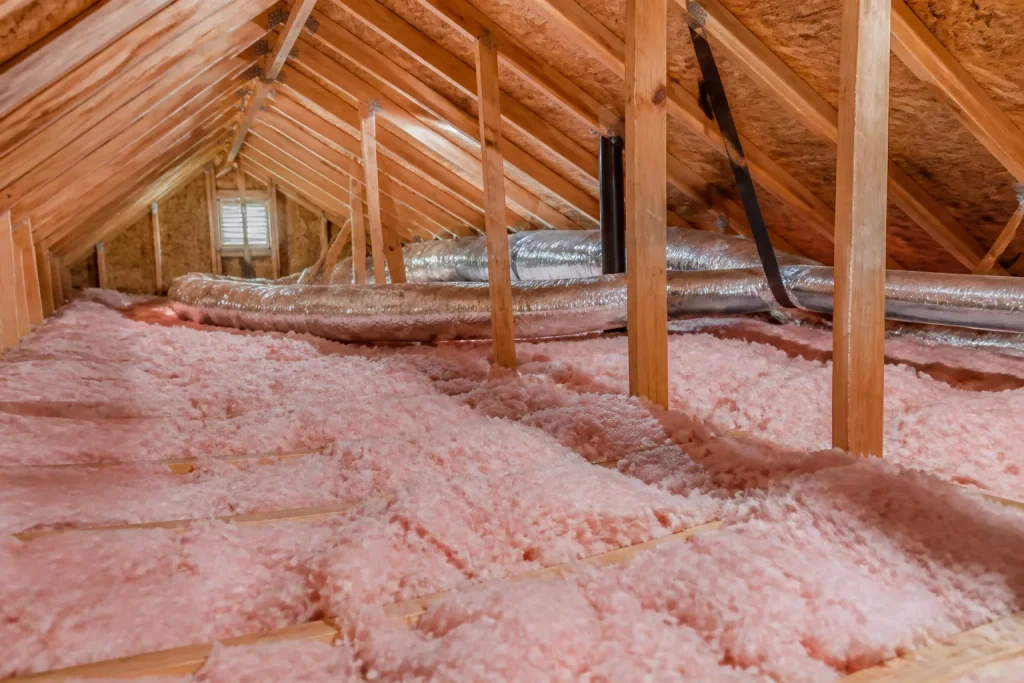
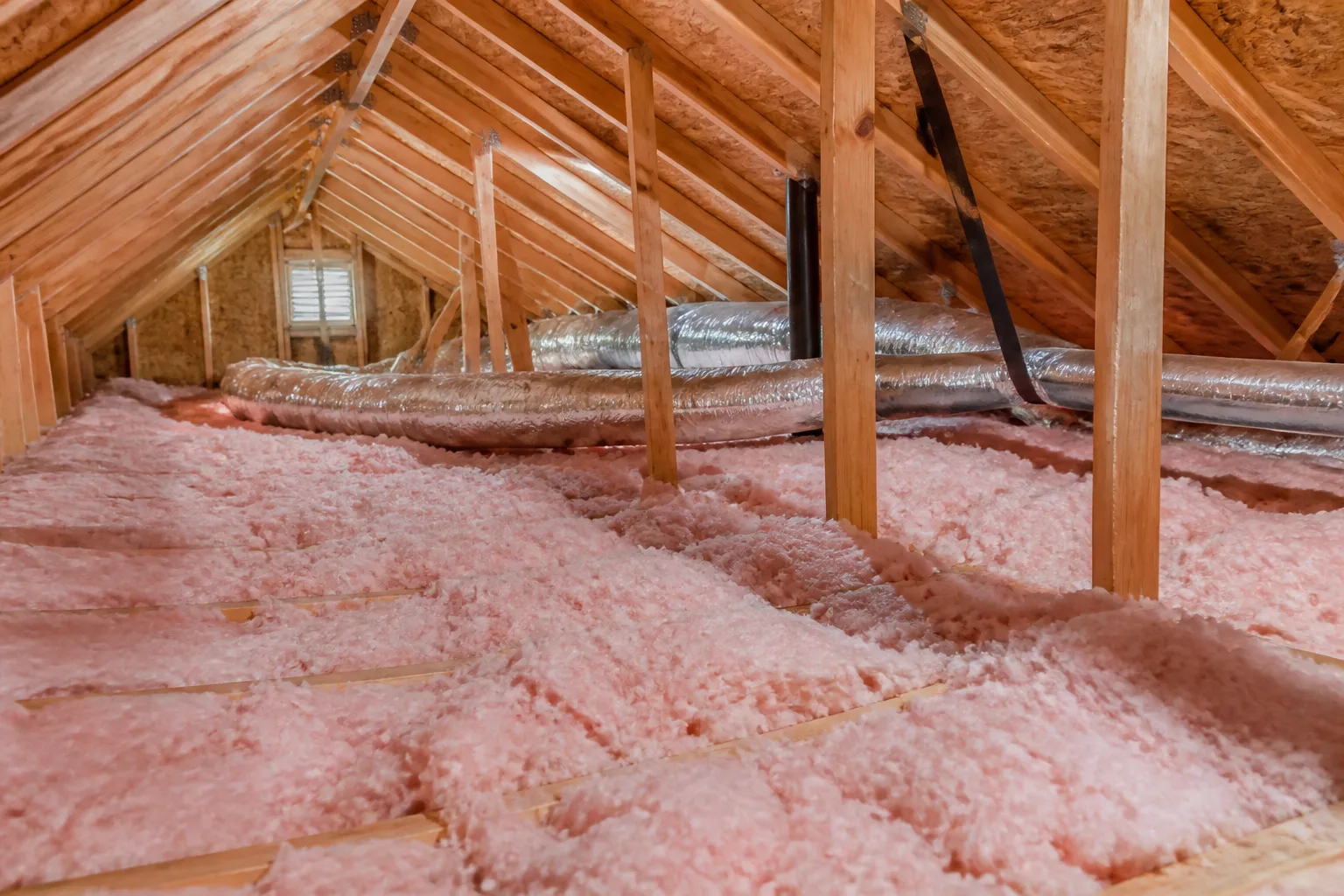
ProPink L77 is Owens Corning’s professional loose-fill blown fiberglass. It’s applied with a commercial blowing machine, which means consistent density and easy coverage around odd framing, recessed light housings, and duct runs. It also settles less than older blown fiberglass products. For Midway City’s typical ranch and mid-century homes with cluttered attic floors, L77 is usually the better fit than batts. It fills the cavity completely, including the awkward areas batts can’t reach without surgery.
AttiCat is Owens Corning’s homeowner-grade blown-in product, sold in bags at big box stores with a free blower rental. It’s not a bad product. But the blowers are underpowered compared to commercial units, and the depth gauges on the bags are optimistic. We’ve measured AttiCat attics in Midway City where the homeowner followed the bag chart precisely and still ended up with R-values 20% below target because of inconsistent density. AttiCat works if you’re patient and methodical. Most people aren’t, through no fault of their own.
If you’d rather skip the product research and have someone handle the details, call Creekside Insulation Co for attic insulation in Midway City at (844) 948-3251. Estimates are free.
Faced vs. Unfaced Batts in Midway City: Why Vapor Control Still Matters in a Dry Climate
Midway City sits in Southern California’s coastal zone. Summer is hot and dry, winter is mild with occasional moisture. That means vapor drive is modest compared to, say, a Florida attic. But it’s not zero, and the faced-versus-unfaced decision still affects your attic’s long-term health.
Faced batts have a kraft paper or foil vapor retarder on one side. The idea is to block moist indoor air from migrating up into the attic and condensing on cool surfaces. In heating-dominant climates, the facing goes down, toward the living space. In Midway City, where we run air conditioning for six months of the year, the vapor drive actually reverses in summer. Warm, humid outdoor air wants to move toward the cooler, drier conditioned space below. If you install faced batts with the paper down and then layer unfaced batts on top, you can create a trap point where moisture collects between the layers.
Our default for Midway City attics is unfaced blown-in or unfaced batts, with any existing vapor retarder carefully evaluated. If you’re topping off an older attic that already has faced batts, the safest play is blown-in loose-fill over the top, not a second layer of faced batts. The facing on the old material already acts as a retarder. Adding another facing layer creates a sandwich that holds moisture.
If you’re unsure what’s currently in your attic, call (844) 948-3251. We’ll look, and we’ll tell you what you’re working with before we recommend anything.
Where Owens Corning Excels in Midway City Conditions, and Where It Doesn’t
Let’s be direct: Owens Corning fiberglass is a known quantity. It’s been installed in millions of attics, and the consistency from bag to bag or batt to batt is reliable. For Midway City’s heat-dominant climate, fiberglass performs well when installed at the correct depth and density. It doesn’t absorb moisture, it doesn’t support mold, and it doesn’t settle dramatically over time when professionally blown. If you want a safe, proven material that won’t surprise you, Owens Corning fiberglass is a solid answer.
But here’s where we earn our keep by being honest. Fiberglass loses effective R-value as attic temperatures climb. That’s true of every fiberglass product, not just Owens Corning. At 130°F attic temperatures, the real-world performance of fiberglass drops noticeably compared to the labeled R-value. Mineral wool, like Rockwool, maintains its R-value across a wider temperature range and adds a fire-resistance bonus that fiberglass doesn’t offer. Certainteed’s blown-in fiberglass is comparable to Owens Corning’s in thermal performance, but certain CertainTeed products pack slightly better coverage per bag, which matters on large Midway City attic floors.
The point isn’t that Owens Corning is a bad choice. It’s that it’s one good choice among several, and the right pick depends on your specific attic conditions. A flat-roofed 1950s bungalow with tight access might call for one approach. A newer two-story with an open truss attic might call for another. We carry Owens Corning, CertainTeed, Knauf, Rockwool, and others because no single manufacturer makes the best product for every situation. The brand conversation should start with your attic, not a catalog.
Installation Details That Make or Break Owens Corning Performance
A good product installed poorly performs worse than a mediocre product installed well. With Owens Corning specifically, three installation habits determine whether you get the R-value on the label.
Batt orientation and butt joints. If batts are your material, every batt must sit flush against the next with no gaps at the butt joints. Even a quarter-inch gap along a 40-foot attic run creates a meaningful thermal strip. Batts should also run the full length of the joist bay without compression at the ends. Compressing a batt to fit a short bay cuts its R-value proportionally. In Midway City attics with true 16-inch on-center framing, standard-width batts fit fine. When framing is irregular, which is common in the older sections of town, we end up cutting and fitting more carefully, and the labor becomes the difference between a good job and a sloppy one.
Depth gauging for blown product. Owens Corning’s blown-in fiberglass achieves its labeled R-value only at a specific blown depth and density. R-38 requires roughly 13 inches of settled fiberglass at the proper density. Most homeowners, and honestly some contractors, eyeball this. Our crew uses depth gauges stapled to the trusses so the person running the hose knows exactly where the target is. Undershooting by two inches can drop the effective R-value by 15% or more. That’s the difference between a noticeable energy bill improvement and wondering why you spent money on insulation.
Venting and airflow. Midway City attics need soffit-to-ridge airflow to manage summer heat. Blowing insulation up against the roofline without baffles chokes the soffit vents and traps heat. That’s not an Owens Corning problem, it’s an installation problem, but it’s the kind of detail that separates a company that does this daily from one that shows up with a rental blower and a prayer. Creekside Insulation Co home has been doing attic work in Midway City long enough to treat baffles, vent chutes, and air sealing as standard procedure, not an upsell.
Reading the Owens Corning Warranty Without the Fine Print Fog
Owens Corning warranties are real, and they’re better than what many insulation manufacturers offer. The standard EcoTouch and ProPink limited warranty covers the product against manufacturing defects for the life of the building, provided it’s installed according to Owens Corning’s published specifications. That’s the key phrase: installed according to specifications.
What voids the warranty? Improper installation, which includes insufficient depth for blown product, compression of batts, installation over a leaky roof deck, or any application Owens Corning didn’t approve. If your attic roof leaks and the insulation gets wet, that’s a roof problem, not an Owens Corning problem. If a contractor installs R-38 where R-49 was specified and you get a cold house, the warranty won’t make up the difference. The warranty covers product defects, not installation errors and not code compliance.
Contractor certification matters more on the installation side than the warranty side. Owens Corning doesn’t require contractor certification for the warranty to be valid, but a contractor who installs the product daily and knows the depth charts, the density requirements, and the baffle details will get you closer to the labeled performance than someone winging it. That’s why we frame the warranty conversation as a quality conversation. The paper matters. The installation matters more.
When to Call a Pro Instead of Going the AttiCat Route
AttiCat is fine for a straightforward attic with easy access, no moisture issues, and no existing insulation complications. If that describes your Midway City attic, and you’re comfortable spending a Saturday sweating in a dust mask, go for it. But call a pro if any of these apply:
- Your attic has old vermiculite insulation that might contain asbestos. Do not disturb it. Get it tested first.
- You see signs of moisture, staining on the roof deck, or rodent activity. Insulating over a problem doesn’t fix it.
- Your attic has recessed can lights that aren’t IC-rated. Blown insulation over non-IC-rated fixtures is a fire hazard.
- You have a low slope or flat roof section where airflow is already marginal. Wrong insulation placement here makes things worse.
- You want air sealing done first. Insulation without air sealing is like putting a sweater on over a holey shirt. The holes still leak.
Related services in Midway City: Spray foam insulation in Midway City for air-sealing and hard-to-reach attic sections, and blown in insulation in Midway City for topping off existing under-insulated attics.
One more thing about DIY blown-in: we pulled a job over in the neighborhood behind Westminster Boulevard last spring where a homeowner had rented an AttiCat blower and filled his attic to what looked like adequate depth. He called us because his bedroom was still 8 degrees warmer than the rest of the house. We found the blower had under-aerated the fiberglass near the far end of the hose run, so the density dropped off badly across the attic. Half the attic was fine. The other half was fluffed up like cotton candy, which insulates about as well as it sounds. He spent the day buying the material and renting the machine, and then paid us to fix it. Sometimes the cheapest route isn’t.
The Right Owens Corning Choice for Your Midway City Home
If you want a simple recommendation: for most Midway City attics, professionally blown Owens Corning ProPink L77 or CertainTeed blown fiberglass at R-38 to R-49, installed with proper depth gauges and vent baffles, is the sweet spot of cost, performance, and durability. If you have attic sections that are impossible to reach or you’re dealing with air leakage around penetrations, Icynene open-cell spray foam handles those specific problems better than any batt or loose-fill. If you have fire-resistance concerns or want sound attenuation between your attic and living space, Rockwool batts are worth the small premium.
The brand on the bag matters less than whether the material matches the job. We carry eight brands because we stopped pretending one manufacturer has the best answer for every attic in Midway City. Owens Corning is an excellent choice when it’s the right choice. That’s a distinction you’ll only get from someone who installs all of them and has no reason to push one over another.
The Bottom Line
Owens Corning attic insulation is a proven, reliable product that performs well in Midway City when the right line is matched to the right conditions. EcoTouch batts suit clean, regular attic framing. ProPink L77 blown fiberglass handles the cluttered, irregular attics common in our older neighborhoods. AttiCat works for patient DIYers but consistently underperforms professional installation on density. Faced versus unfaced decisions still matter even in our dry climate, and the warranty is only as good as the installation it sits on.
If you’re in Midway City and want a straight answer about what your attic actually needs, Creekside Insulation Co offers free estimates. Call (844) 948-3251 and we’ll climb up, look around, and tell you what we’d do if it were our house. No pressure, no brand lecture, just an honest recommendation backed by eight brands and years of local attic work.
Frequently Asked Questions
For a typical Midway City attic, professionally installed Owens Corning blown-in fiberglass at R-38 runs roughly $1,800 to $2,600 depending on attic size, access difficulty, and whether air sealing is included. Batts run slightly higher on labor. Call (844) 948-3251 for an exact quote, free of charge.
Yes, when the specific Owens Corning product line fits your attic conditions. ProPink L77 is consistent and reliable. But CertainTeed matches it on thermal performance at a similar price, and Rockwool outperforms it on fire resistance and sound control. The right brand depends on the job.
Yes, if your attic is accessible, unobstructed, and free of moisture, vermiculite, or non-IC-rated lighting. The most common DIY shortfall is inconsistent blown density, which cuts effective R-value. If you’re unsure, have an attic inspected before you buy material.
All fiberglass products, including Owens Corning, lose effective R-value as attic temperatures climb past 120°F. Mineral wool like Rockwool holds its R-value more consistently in high heat. In Midway City summers, this actually matters, and it’s worth discussing for homes with older, hotter attic designs.
Written by the team at Creekside Insulation Co, serving Midway City since 2016.
Need Insulation Help?
Call Creekside Insulation Co — licensed & insured, here with fast after-hours help in Midway City.
(844) 948-3251