
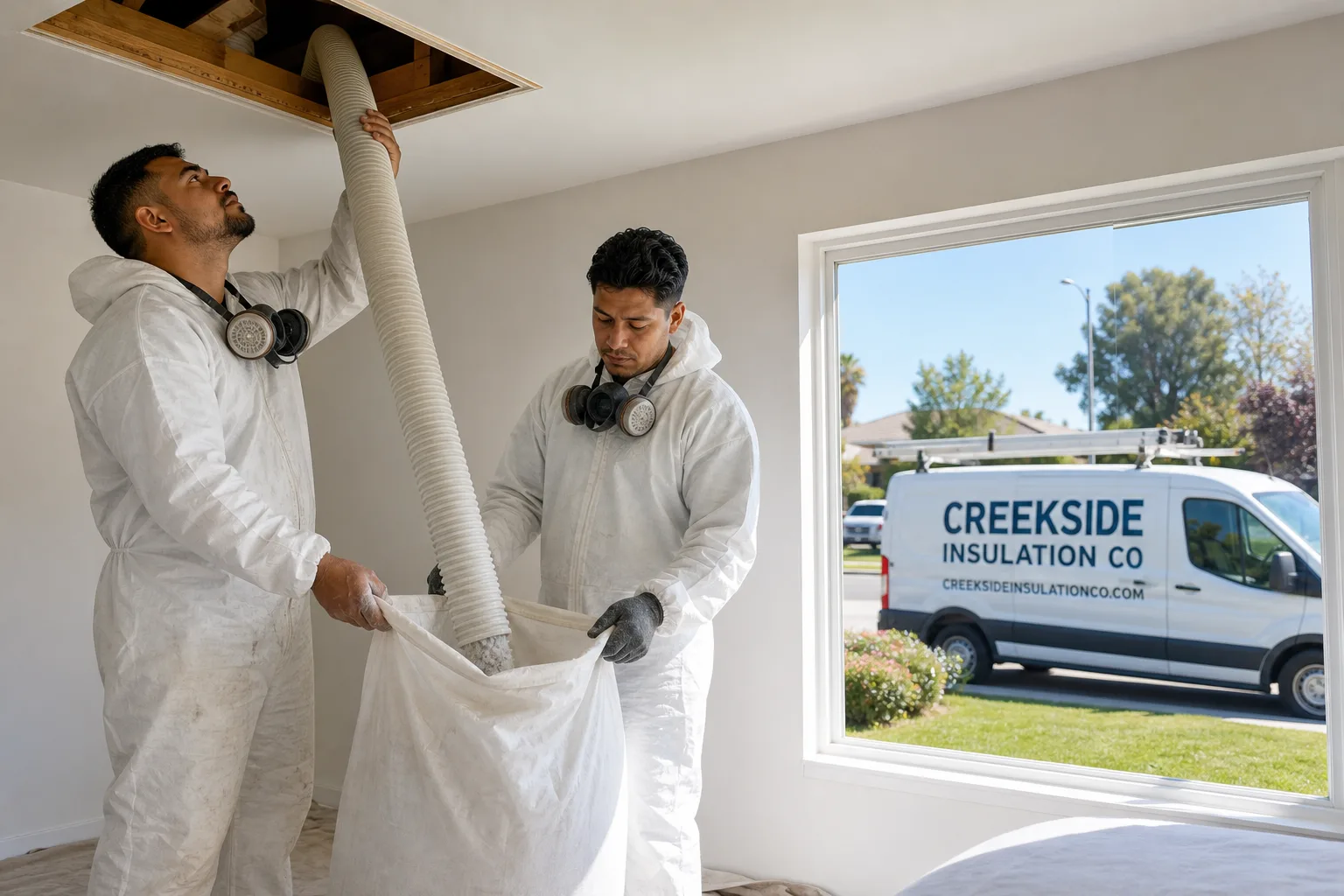
Spray Foam Insulation in Signal Hill: Built for Heat, Noise, and Oil-Field Adjacency
Spray foam insulation in Signal Hill typically runs $2.50 to $6.50 per square foot depending on whether you choose open-cell or closed-cell, and most homeowners recover that cost within three to five years through lower cooling bills. But in this city, the conversation goes beyond energy savings. Signal Hill isn’t like the flat grid of Long Beach a few blocks south. It’s a small, fully built-out hilltop wrapped in active and capped oil wells, tank farms, and industrial parcels, and the homes here face a set of conditions most insulation crews never see. Our team knows those conditions because we’ve worked inside the attics and walls of enough Signal Hill homes to understand what’s actually happening beneath the stucco.
If you’re dealing with a hot upstairs, rooms that never hold temperature, or a low industrial hum that seeps through shared walls, call us at (844) 948-3251. We’ll diagnose what’s going on and give you a straight answer about whether spray foam is the right tool for your home.
Why Signal Hill Homes Need a Different Kind of Insulation Company
Signal Hill is the only city in the region where residential streets sit directly on top of an active oil field. The same hills that gave the city its name are dotted with working wells, capped pads, and tank battery sites wedged against single-family lots. Homes on the upper streets off Hill Street, Cherry Avenue, and Skyline Drive back onto these industrial parcels. The insulation work here is as much about separating living space from noise, vibration, and odor as it is about lowering energy bills.
We learned this the hard way, working job after job in the 90755 zip code. A crew that understands Signal Hill knows the difference between a standard attic retrofit and one where closed-cell foam needs to serve as a containment barrier against diesel exhaust and well-pad hum. That’s why our Spray Foam Insulation team always does a site-specific assessment before recommending anything. We look at what’s behind the wall, what’s above the ceiling, and what’s across the fence line.
Spray Foam Attic Insulation in Signal Hill
Spray foam attic insulation in Signal Hill starts around $2.50 per square foot for open-cell and $4.00 to $6.50 per square foot for closed-cell, with most single-story ranch attics landing between $3,800 and $7,500 total. The job matters more here than in most Southern California cities because of how local roofs behave. Signal Hill’s post-war homes, mostly built between the 1940s and early 1960s, were constructed with thin framing and little to no original attic insulation. The sun hits those unshaded roof decks hard through the summer, and heat radiates down through the ceiling into living space. Spray foam on the attic roofline stops that transfer at the source.
But there’s a catch specific to Signal Hill. Foam sprayed directly against a sun-exposed mid-century roof deck without a venting or radiant-control plan won’t work the way it should. The deck gets hot enough that the foam can cure unevenly and hold heat the attic was never designed to shed. That’s why we always pair attic foam with an air-sealed, properly vented attic design. The foam handles the air sealing. The venting handles the heat. Both have to be right.
Open-Cell on the Attic Roofline
Open-cell spray foam, like Icynene’s classic formula, creates an air seal that stops the stack effect pulling conditioned air out of the home. In Signal Hill’s coastal-influenced climate, where marine-layer mornings give way to dry inland afternoons, the bigger win is holding cool air inside during summer. Open-cell is the more affordable option and works well when the attic is ventilated correctly and the roof deck is in decent shape.
Closed-Cell for Radiant Heat and Containment
Closed-cell foam, installed at two inches or more, adds a vapor barrier and a denser, higher-R barrier per inch. For Signal Hill homes backing onto well pads or tank sites, closed-cell on the attic roofline does double duty: it reflects more radiant heat and blocks the slow migration of industrial odors through roof vents and eave gaps. The material costs more, but the performance difference is real in these conditions.
Spray Foam Wall Insulation in Signal Hill
Spray foam wall insulation in Signal Hill runs $3.00 to $6.50 per square foot depending on whether walls are being injected during a retrofit or insulated when framing is exposed. The retrofit route, which is the most common for Signal Hill’s existing homes, involves drilling access points through the stucco and injecting foam into the wall cavities. This is the single most effective way to stop drafts, noise, and odor intrusion in a home that was never built with insulation in mind.
Most Signal Hill homes from the post-war building boom have stucco exteriors over wood framing. The stucco gives a false impression of solidity. Behind it, there’s often an uninsulated cavity with nothing but a layer of building paper separating the interior from whatever’s outside. When that outside includes a tank battery pad or a busy industrial corridor, the result is noise and smell finding its way into bedrooms and living spaces through every seam and penetration.
Wall Cavity Injection
We inject open-cell or low-expansion closed-cell foam into wall cavities through small access points, filling the space from sill plate to top plate. The foam seals around knob-and-tube-era framing, electrical runs, and plumbing penetrations as it expands, closing the gaps that let drafts, damp air, and odor migrate through the wall. It’s precise work, and it changes how a home feels almost immediately.
Closed-Cell on Shared and Well-Adjacent Walls
For walls that face a well pad, an industrial parcel, or a busy road like Cherry Avenue or Willow Street, closed-cell foam is the right call. It’s denser, acts as a vapor retarder, and does a better job of damping vibration and low-frequency noise. We’ve seen this play out on upper Hill Street neighborhoods where homes back directly onto capped well sites. The difference between a bare cavity and a closed-cell-filled cavity is the difference between living with industrial hum and not noticing it.
On one 1950s ranch off Hill Street, we foamed the attic roofline with two inches of closed-cell Icynene and injected the walls at the same time. The original stucco was still in place, and the attic had never been touched. We paired the attic foam with an air-sealed, vented plan so the sun-baked roof deck wouldn’t cook the foam in the afternoon. The owners told us the low industrial hum and diesel odor they’d lived with for years finally stopped. The house held its temperature through marine-layer mornings and dry afternoons for the first time since they’d owned it.
Trusted Brands We Service in Signal Hill
We install spray foam from Icynene and Demilec, two of North America’s most respected foam manufacturers. That covers both open-cell and closed-cell formulations, so the recommendation comes down to what your Signal Hill home actually needs, not what we happen to have on the truck. For homeowners near Signal Hill who are also considering hybrid approaches, we carry complementary products from Owens Corning, Johns Manville, Knauf, and GreenFiber. Bringing eight brands to the table means we don’t have a reason to push one material over another. We recommend what fits the house, the budget, and the conditions across the fence line.
Common Spray Foam Insulation Problems We See in Signal Hill Homes
- Foam failing against sun-exposed mid-century roof decks. Homes from the 1940s and 1950s along Skyline Drive and the upper streets were never designed for spray foam. When foam is applied directly to a hot roof deck without venting, it can overheat, off-gas, and trap heat the attic was built to shed. We see it on retrofit jobs done by crews that don’t understand Southern California sun loads.
- Closed-cell cracking at framing joints on well-adjacent walls. Vibration from well pads, tank trucks, and industrial operations transmits through the ground. Over time, closed-cell foam applied to shared walls without accounting for that movement can crack and lose its air seal. We account for it at the design stage, which is why our Signal Hill work holds up.
- Gaps around knob-and-tube-era penetrations. Original 1940s-through-1960s framing left dozens of unsealed penetrations in every wall: where wires enter, where pipes pass, where framing meets the floor. Foam that doesn’t reach those gaps leaves channels for odor and damp air. It takes a thorough prep pass to catch them all.
- Single-material solutions on homes that need a hybrid approach. Not every Signal Hill home needs full foam. Some attics are better served with foam air sealing plus blown-in cellulose or fiberglass. The mistake is a crew that only offers one thing. We stock eight brands so the answer is always what works, not what’s easiest.
Pricing for Spray Foam Insulation in Signal Hill, CA
Here’s what Signal Hill homeowners can expect to pay. Open-cell attic foam runs $2.50 to $4.50 per square foot installed. Closed-cell runs $4.00 to $6.50 per square foot. Wall cavity injection falls in the $3.00 to $6.00 per square foot range depending on access and cavity depth. A full attic retrofit on a typical 1,200-square-foot ranch runs $3,500 to $7,500. A whole-home wall injection project typically lands between $6,000 and $14,000 depending on the home’s size and how many walls face industrial or traffic exposure. The variables are cavity depth, access difficulty, and whether we’re working around knob-and-tube-era wiring that needs extra care. Every quote is itemized, and the estimate is free. Call (844) 948-3251 and we’ll give you a real number, not a vague range.
We Also Serve Cities Near Signal Hill
Our crews work throughout the South Bay and Long Beach area, including Long Beach, Lakewood, Carson, and Hawaiian Gardens. If you’re in a neighboring city with the same coastal conditions and mid-century housing stock, we’re happy to help. The material options and installation standards are the same across every city we serve.
Serving Signal Hill, CA — Our Local Coverage Area
We’re based in the Signal Hill area and know this community well. Use the map below to see our service coverage — if you’re nearby, we can almost certainly help.
FAQs About Spray Foam Insulation in Signal Hill
Yes. Closed-cell spray foam is the best available material for damping low-frequency industrial noise and blocking odor migration through walls and attic planes. On Signal Hill’s upper streets where homes back onto capped or active well sites, closed-cell foam on shared walls and attic rooflines creates a barrier that open-cell or fiberglass can’t match. The density of closed-cell foam means sound doesn’t pass through as easily, and the air seal stops odor molecules from finding their way through gaps. If you’re living with that hum or diesel smell, call (844) 948-3251 for a site assessment.
You can, but only if the attic is vented correctly. Spraying foam directly against a sun-baked roof deck without a venting plan causes the foam to overheat and the attic to trap heat it was never designed to hold. We pair foam with a proper vented attic design: intake vents at the eaves, exhaust at the ridge, and an air-sealed attic floor below the foam line. That keeps the roof deck and the foam layer at the right temperature while the home’s conditioned air stays where it belongs.
Yes. Spray foam injection works well in post-war ranch homes with stucco exteriors and original framing. The foam fills irregular cavities around older framing members, electrical lines, and plumbing, which is exactly what these homes need. The key is a careful prep pass to locate and seal all the penetrations those older homes are full of. We’ve insulated dozens of these ranches in the 90755 area, and they respond dramatically to the work.
We install Icynene and Demilec spray foam. Icynene’s open-cell formula is our go-to for attic rooflines and wall cavities where ventilation and cost are priorities. Demilec’s closed-cell foam is the choice for well-adjacent walls, shared walls, and any application where vapor control and noise damping matter. Both are premium North American brands with long track records. We don’t push whichever foam is cheapest to stock; we match the product to the home’s specific conditions.
It makes sense for the right reasons. Signal Hill’s climate is mild, so the energy payoff from foam alone is smaller than in a cold climate. But the air sealing, noise damping, and odor blocking are exactly what homes here need, especially those facing industrial parcels, busy streets like Cherry Avenue, or well-pad adjacency. If your home has comfort problems, drafts, or noise intrusion, foam solves them in a way batts never will. If your home is already comfortable and quiet, a less expensive option might be the right call. That’s the honest answer, and it’s the one you’ll get when you call (844) 948-3251.
Get a Free Spray Foam Insulation Estimate in Signal Hill
If you live in Signal Hill and you’re tired of rooms that won’t hold temperature, a utility bill that climbs every summer, or noise from the oil field that creeps into your home, let’s talk. We’ll inspect your attic and walls, explain what’s actually going on, and give you a written estimate for the right solution, whether that’s open-cell, closed-cell, or a hybrid approach. Call Creekside Insulation Co at (844) 948-3251 to schedule your free assessment.
Written by Noel Ibarra, Owner at Creekside Insulation Co, serving Signal Hill and the surrounding South Bay cities.