
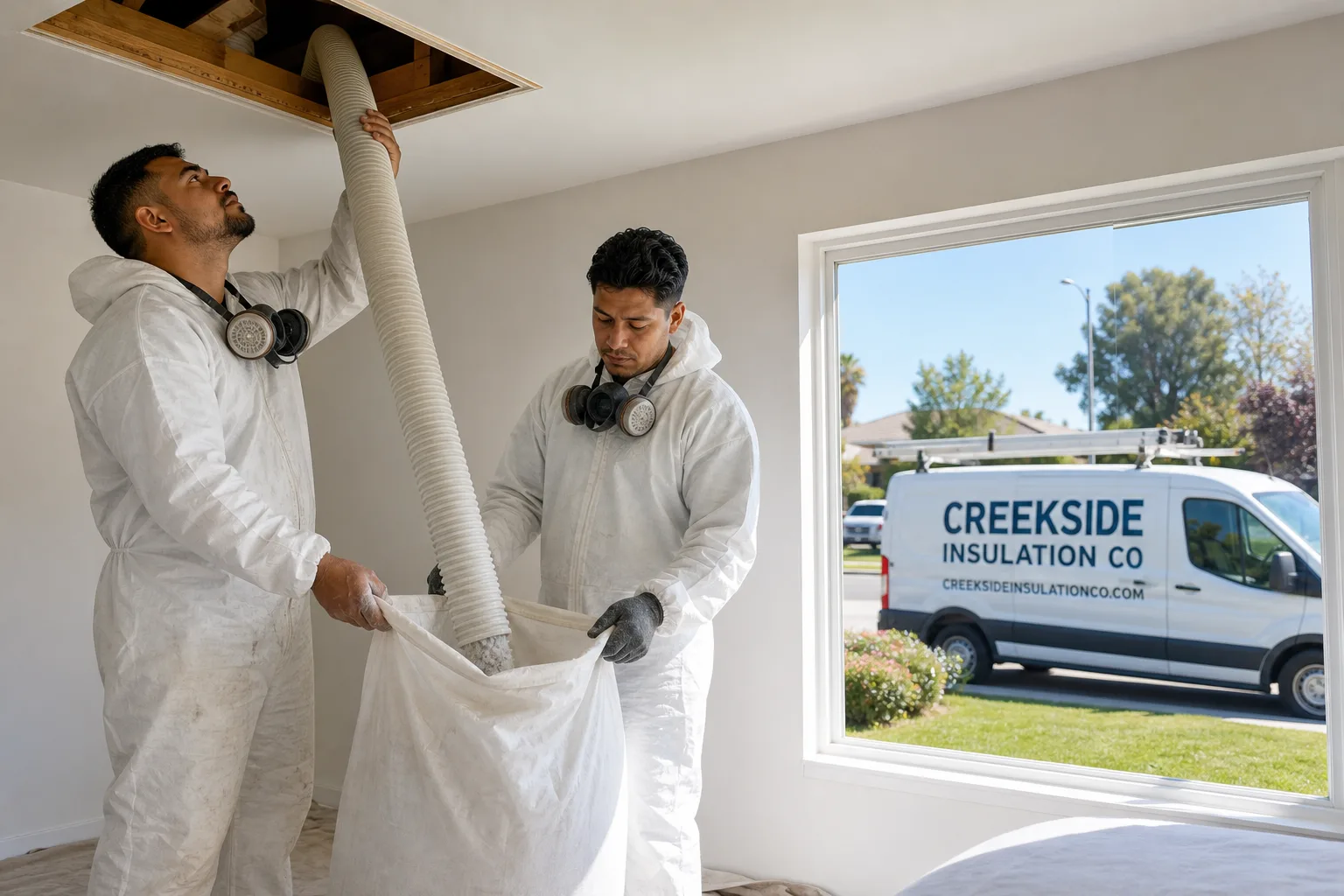
Fast, Reliable Spray Foam Insulation Across Rossmoor
Spray foam insulation in Rossmoor typically costs $2,800 to $9,500 depending on the scope, and because every job here is a retrofit on a 1960s tract home, we quote each one after seeing the attic and slab junction in person. Rossmoor’s roughly 3,800 homes were built between 1958 and the mid-1960s, and most still carry the original fiberglass batts the builders stapled in six decades ago. Those batts are now settled, compressed, and doing almost nothing against the afternoon heat that hits west-facing walls off the marine layer. If you’re noticing rooms that bake by 2 p.m. or a house that never holds its temperature, the insulation in your attic and walls is the likely culprit. Call us at (844) 948-3251 and we’ll come out to Rossmoor, walk the attic with you, and give you a straight answer about what’s actually going on up there.
We’re Creekside Insulation Co, and we’ve spent enough time inside Rossmoor attics to know exactly what these homes need. Not every contractor wants to crawl through a low-pitch attic on a Ranchwood tract home, but that’s the job, and we’ve gotten good at it.
Why Creekside Insulation Co Is Rossmoor’s Preferred Spray Foam Insulation Company
Rossmoor homeowners call us because we understand the specific construction these 3,800 homes share: slab foundations, wood-frame walls, stucco exteriors, and attics that were never designed with modern insulation in mind. When you live in Rossmoor, you don’t need a contractor who mostly does new construction in Irvine or Tustin. You need someone who knows what happens when you spray foam into a 1963 Ranchwood attic with rafter bays too shallow for a standard pass, or how the coastal humidity off Seal Beach affects cure times in the morning marine layer.
Our crews work in Rossmoor regularly. We know to watch for the original single-pane aluminum sliders the builders installed, because radiant heat pushing through those frames stresses any foam seal at the wall junction. We know the Community Services District keeps a close eye on exterior changes, so we plan every attic penetration carefully. And we know that when a homeowner off Montecito Road says their west-facing bedrooms are uncomfortable by early afternoon, it’s almost always an insulation and air-sealing failure, not an HVAC problem. That local knowledge saves Rossmoor residents money and keeps us from recommending work they don’t need.
We carry both open-cell and closed-cell formulations from Icynene and Demilec, two of North America’s most respected foam manufacturers. When we recommend a product for your Rossmoor home, it’s because the material matches your roof deck, your slab junction, and your humidity profile, not because it’s the only option on our truck. Noel Ibarra leads our team, and he’ll tell you straight if your home would be better served by Rockwool batts or blown-in GreenFiber cellulose instead of spray foam. That’s the benefit of carrying eight brands across every major insulation category: no pressure to sell a single product line.
Closed Cell Spray Foam Insulation in Rossmoor
Closed Cell Spray Foam Insulation is the workhorse for Rossmoor homes with slab-to-wall junctions, ductwork in unconditioned attics, and west-facing walls that absorb the afternoon heat. Closed cell cures rigid and dense, around 2 pounds per cubic foot, which means it adds structural strength to the roof deck while acting as an air barrier, vapor barrier, and insulator in a single application. In a Rossmoor tract home with a low-pitch attic and original stucco, that triple function matters more than it does in newer construction.
For Rossmoor specifically, closed cell is our go-to recommendation along the slab-to-wall junction where the 1960s builders left gaps between the foundation and the wall plate. Those gaps let in the damp, salty air that drifts in from the coast every night, and once that moisture reaches the framing, it sets up the conditions for rot and mold. Closed cell foam seals the junction and locks the moisture out. It’s also the right call when the Community Services District’s aesthetic rules mean you can’t add new gable vents or wall penetrations that would normally help an attic breathe. Closed cell gives you the air-sealing you need without touching the stucco exterior.
What Closed Cell Costs in Rossmoor Attics
A typical closed-cell application on a Rossmoor attic roof deck runs $3.50 to $5.50 per board foot installed. For a standard 1,600-square-foot Ranchwood or Rossmoor Highlands home, that usually lands between $5,500 and $9,500 for full attic deck coverage at 2 to 3 inches of depth. Slab-to-wall junction sealing alone runs $800 to $1,800 depending on how much of the perimeter is accessible. These are Rossmoor-specific figures, because our crews already know the attic geometry, the access logistics, and what these 60-year-old homes require for prep work.
Slab-to-Wall Junction Sealing
The gap where your 1960s slab meets the wall plate is a highway for coastal air and the occasional ant colony. We cut away any drywall that’s concealing the junction, clean the area, and apply closed cell foam directly against the gap. On Rossmoor homes with original baseboards and slab flooring, we work carefully to minimize the intrusion and leave the finish looking like we were never there.
Open Cell Spray Foam in Rossmoor
Open Cell Spray Foam is the workhorse for Rossmoor attic roof decks where you need air sealing and thermal performance but don’t want the density or cost of closed cell. Open cell cures softer and lighter, around half a pound per cubic foot, and it expands to fill every irregular rafter bay, corner, and gap those 1960s framers left behind. It’s an air barrier first, which means it stops the conditioned air you paid to cool from leaking out through the attic.
In Rossmoor’s specific climate, open cell makes sense for the main attic deck when the home already has reasonable ventilation and the primary problem is heat gain through the roof, not moisture intrusion at the foundation. The marine layer burns off by mid-morning, and by early afternoon the sun is hammering the low-pitch roof. Open cell foam at 5 to 6 inches on the deck keeps that radiant heat from turning your attic into an oven and your west-facing bedrooms into saunas. It does require proper ventilation because open cell absorbs moisture if the attic stays damp, which is a real concern in Rossmoor’s coastal humidity. We inspect ventilation before recommending it, and we’ll tell you if your home needs closed cell instead.
What Open Cell Costs in Rossmoor Attics
Open cell in Rossmoor runs $2,000 to $4,500 for a typical 1960s tract home attic deck at 5 inches of depth, which works out to roughly $1.25 to $2.00 per board foot installed. Rim joist sealing with open cell runs $600 to $1,400 for an average Rossmoor single-story. If your ductwork runs through the unconditioned attic, we often recommend sealing the attic deck and bringing the ductwork inside the conditioned envelope, which is where open cell really shines on these homes.
Attic Deck and Rim Joist Application
We apply open cell in staged passes through Rossmoor’s low-clearance attics, where standard spray rigs don’t fit and you can’t reach every rafter bay from a standing position. The foam expands as it cures, so we work in thin lifts to account for the morning marine air, which can slow cure times and cause adhesion issues if you rush the passes. It’s slower work than a standard new-build attic, but it’s what these homes require for a proper seal.
Trusted Brands We Service in Rossmoor
We’re authorized to install products from eight manufacturers, including Owens Corning, Johns Manville, Knauf, and Rockwool, and our spray foam work runs through Icynene and Demilec. That’s not a marketing list; it means when we’re in a Rossmoor attic and the homeowner asks why we’re recommending Icynene open cell over Demilec closed cell, we can answer with actual material data and local experience, not a sales script. For Rossmoor customers, carrying multiple brands also means we’re not tied to a single product line’s stock or price schedule. If a material goes on backorder, we have alternatives ready, which keeps your project moving. Eight brands, one honest recommendation, backed by someone who’s actually been in your attic.
Common Spray Foam Insulation Problems We See in Rossmoor Homes
- Marine-layer humidity wicking into open cell at the slab junction. Rossmoor’s nightly fog rolls in from the coast and settles right at the foundation line, so any open cell touching the slab-to-wall junction can collect moisture and hold it against the framing. We see this on homes where someone sprayed open cell into the junction without sealing the vapor profile first.
- Low-pitch attics causing uneven foam adhesion on rafter bays. The shallow attic ceilings on Ranchwood and Rossmoor Highlands homes force installers to work at awkward angles, and in cool morning marine air the foam cures slower than it would in a dry inland attic. If the passes are rushed, you get adhesion gaps at the top of the rafter bays that leak air right back into the conditioned space.
- Radiant heat pushing foam against original aluminum slider frames. West-facing walls in Rossmoor absorb the afternoon sun, and original single-pane aluminum sliders transfer that heat directly into the frame pockets. Spray foam sealed tight against those frames expands and contracts with the heat cycle, which stresses the seal at penetrations the Community Services District already scrutinizes if you try to modify them.
- Original settled fiberglass batts left in place under new foam. A lot of Rossmoor homeowners assume you can spray foam right over the original 1960s batts, but those batts are compressed and sagging and they create an uneven surface that makes proper foam adhesion impossible. We remove them before spraying, then address the air gaps underneath so the foam does the whole job.
Pricing for Spray Foam Insulation in Rossmoor, CA
Here are real numbers for Rossmoor, not national averages. Open cell attic deck coverage on a standard 1960s tract home runs $2,000 to $4,500, closed cell roof deck coverage runs $5,500 to $9,500, slab junction sealing runs $800 to $1,800, and a full open-and-closed combination job (attic deck plus slab junction) usually lands between $3,500 and $7,000. What moves the number: whether your attic is Ranchwood-tight or has slightly more headroom, whether we’re removing old batts first, whether ductwork needs sealing, and whether the Community Services District’s facade rules require us to route penetrations differently than we would in Cypress or Los Alamitos. Call (844) 948-3251 and we’ll give you a written quote after walking the property. Estimates are free, and the quote is the number, not a jumping-off point for upselling.
We Also Serve Cities Near Rossmoor
We work throughout the Seal Beach-adjacent communities around Rossmoor, including Los Alamitos, Cypress, Hawaiian Gardens, and La Palma. If you’re in one of those nearby cities and need Spray Foam Insulation work done by a crew that knows coastal Orange County construction, give us a call. For the full picture of our work in this community, see our Rossmoor service area page.
Serving Rossmoor, CA — Our Local Coverage Area
We’re based in the Rossmoor area and know this community well. Use the map below to see our service coverage — if you’re nearby, we can almost certainly help.
FAQs About Spray Foam Insulation in Rossmoor
Yes, in most cases we can route the foam application to avoid any new exterior penetrations, which is exactly how we handle Rossmoor’s aesthetic rules. Closed cell foam on the roof deck acts as its own air and vapor barrier, so you don’t need to add gable vents or wall louvers that would alter the stucco facade. We work entirely from the attic side and the interior slab junction, then plan the ventilation strategy around what your home already has. If your attic genuinely needs additional airflow, we’ll talk through options that don’t touch the exterior, such as improving soffit ventilation from the underside. Call (844) 948-3251 to schedule a look at your attic.
No. The original fiberglass batts in Rossmoor’s 1960s homes have settled and compressed to a fraction of their original R-value, and spraying foam over them creates an uneven, unstable surface that prevents proper adhesion and leaves air gaps underneath. We remove the old batts first, assess the rafter bays and any existing air leaks, then apply the foam directly to the roof deck or wall surface. Leaving them in place is a shortcut that compromises the whole job, and we don’t do shortcuts on homes that have stood since the Kennedy administration. Call us for a free estimate and we’ll show you what’s up there.
For most Rossmoor attics with ductwork running through the unconditioned space, we recommend sealing the attic deck with open cell and bringing the ductwork inside the conditioned envelope, which is far cheaper than rerouting ducts. If the attic has documented moisture issues from the coastal marine layer, or if the Community Services District restrictions limit what ventilation changes you can make, we lean toward closed cell on the deck instead. The decision hinges on your specific attic’s humidity profile and the condition of your existing ductwork, and we’ll tell you which one makes sense after inspecting both. Call (844) 948-3251 and we’ll get into the details.
Yes, the salt air does not break down cured polyurethane foam itself, but it corrodes the hardware the foam relies on: the fasteners, flashing, and any metal penetrations through the roof deck or wall plates. Rossmoor’s marine layer also carries moisture that open cell foam can absorb if the attic isn’t ventilated properly, which is why we spec closed cell at the slab junction and inspect every metal surface before we spray. Using corrosion-resistant fasteners and sealing penetrations tightly keeps the salt air from working its way into the assembly. If your attic has older metal hardware that’s already corroding, we’ll flag it during the walkthrough and recommend the right fix.
Yes, sealing the attic deck and the wall-to-slab junction with spray foam directly reduces the late-afternoon heat load on west-facing walls because it stops radiant heat from the roof deck from radiating into the living space through the ceiling and it blocks the hot air that otherwise migrates from the attic into the wall cavities. On a Ranchwood tract home off Rushmoore, we removed settled fiberglass batts from the compressed rafter bays, applied Icynene open-cell foam to the attic deck and closed cell along the slab-to-wall junction, then sealed the ductwork running through the unconditioned attic. The homeowner reported the late-afternoon heat gain on the west wall dropped noticeably within the first week. Call (844) 948-3251 for a free assessment and we’ll tell you exactly what’s realistic for your home.
Written by Noel Ibarra, Owner at Creekside Insulation Co, serving Rossmoor and the surrounding OC communities.