
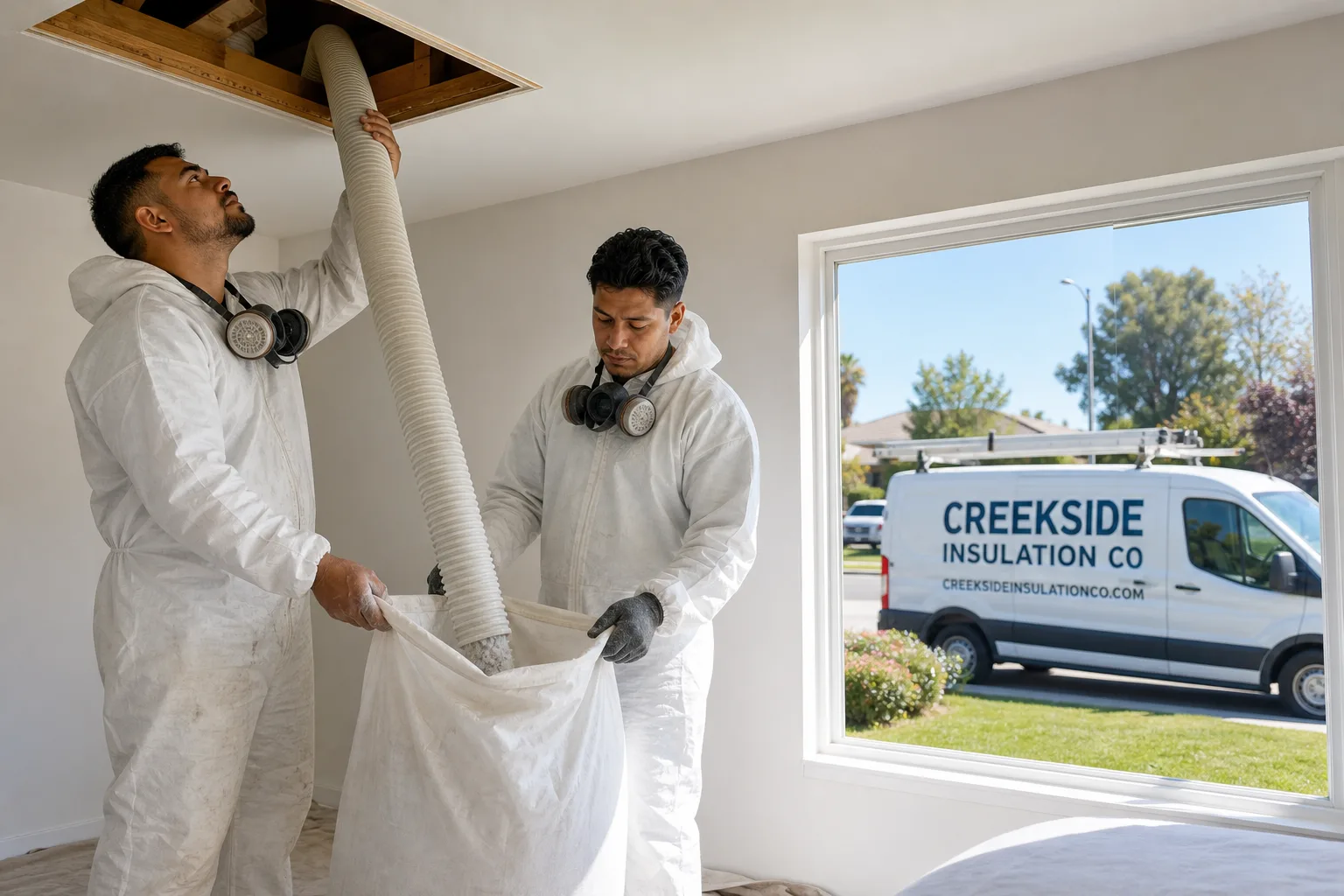
Fast, Reliable Spray Foam Insulation Across Long Beach
Spray foam insulation in Long Beach typically runs $2.50 to $6.50 per board foot installed, with most whole-attic jobs landing between $3,800 and $9,200 depending on foam type and square footage. But the real variable here isn’t square footage. It’s moisture. Long Beach’s marine layer pushes damp salt air into attics and garage cavities every night, which means the difference between a successful foam job and a callback is how well we handle venting and vapor control before the first drop of foam leaves the gun. We send crews across Long Beach from Signal Hill to the Peninsula, and we know exactly what this coastal air does to a 1920s bungalow’s roof deck. Call (844) 948-3251 for a free estimate and an honest read on whether spray foam is the right material for your specific house.
Why Creekside Insulation Co Is Long Beach’s Preferred Spray Foam Insulation Company
We’re not the biggest insulation crew in Long Beach, and we’re fine with that. We built our name here by treating every retrofit as a diagnosis first. Long Beach homes span 1920s oil-boom bungalows near Retro Row, 1950s tract houses in Los Altos, and low-rise apartment buildings along 7th Street where wall cavities were never insulated to begin with. That variety means a product recommendation has to match the house, not our shelf. We carry Icynene and Demilec spray foam, both open-cell and closed-cell, alongside fiberglass, mineral wool, and cellulose options, so when we tell a homeowner in Bixby Knolls that closed-cell is the right call for a damp garage, it’s because the house asked for it. Noel Ibarra started Creekside on a simple principle: eight brands, one honest recommendation. Long Beach customers hear us say “spray foam isn’t the answer here” more often than they expect, and that’s exactly why they call us back for the next project.
Response time to Long Beach? We’re based nearby in Midway City, so we can usually have a crew on site within one to two business days for an estimate, sooner for emergency work. That matters when you’ve already got damp insulation against your ceiling drywall and the smell is working its way into the living room. We know the east-side stucco tracts, the shoreline condos, the hillside homes with shallow attics. That local familiarity means the estimate we give you reflects real conditions, not a national average.
Garage Spray Foam Insulation in Long Beach
Garage Spray Foam Insulation in Long Beach addresses a very specific problem here: the garage is where salt air and daily temperature swings hit hardest, especially in homes within a mile of the water. We regularly see garage-door springs, hinges, rollers, and opener chains corroded years ahead of schedule. Salt air off the beach eats ferrous hardware in three to five years instead of the ten to fifteen inland homeowners expect. That matters for spray foam because spraying over rusted fasteners or corroded tracks traps moisture against them and accelerates the decay from inside the wall cavity. The work involves inspecting and, where needed, replacing corroded hardware with galvanized or coated springs and stainless fasteners, then applying foam to the ceiling and walls to stop air movement and condensation. A typical attached garage in Long Beach runs $1,800 to $4,200 for full spray foam coverage, depending on whether we’re doing the walls, the ceiling, or both.
Corrosion Inspection Before Foam
We don’t spray over rust. On a 1928 bungalow just off Ocean Boulevard in Belmont Shore, our crew found the garage-door springs and opener chain already rusted through. Salt air off the beach had eaten them years faster than inland hardware. Before we sprayed the garage ceiling, we swapped in galvanized springs and stainless fasteners, then ran closed-cell foam across the garage walls to block the damp marine air. The homeowner’s overhead door stopped sticking within a week, and the ceiling condensation quit within a month.
Closed-Cell on Garage Walls
Long Beach garages that face the prevailing onshore breeze trap humidity fast. Closed-cell foam on the garage side walls acts as both an air seal and a vapor retarder, which keeps that damp marine air from condensing on framing and drywall. Open-cell has its place in vented attics, but against a garage wall exposed to salt-laden air, closed-cell is usually the right match.
Closed Cell Spray Foam Insulation in Long Beach
Closed Cell Spray Foam Insulation in Long Beach is the workhorse for homes where moisture control matters more than raw R-value. Long Beach sits in a mild coastal marine climate where overnight dampness, morning fog, and salt air are the real villains. Closed-cell foam cures into a rigid, water-resistant air barrier that both insulates and blocks bulk moisture movement. We recommend it most often for crawlspace rim joists, garage ceilings, roof decks, and any wall cavity in older homes where the original plaster and lathe assembly never had a vapor barrier. The Long Beach price range for closed-cell runs $1.90 to $3.50 per board foot for materials, with installed jobs landing between $4.50 and $6.50 per board foot depending on depth and access.
Rim Joist Sealing in Older Long Beach Homes
In a 1930s bungalow in Rose Park, the rim joist is often a bare board sitting directly over a damp crawlspace. Closed-cell foam sprayed to the rim joist stops the stack effect that pushes crawlspace moisture into the walls. We do this on almost every spray foam job in Long Beach’s older neighborhoods because it’s the highest-impact, lowest-square-footage improvement a homeowner can make.
Roof Deck Foam and Marine-Layer Condensation
Spray foaming the underside of a roof deck changes the attic’s thermodynamics. In Long Beach, where the marine layer sits on the roof most nights between May and August, a roof deck that’s suddenly insulated on the inside becomes the first surface to reach dew point. If the original eave vents got sealed during the retrofit, that dew point condenses right on the deck and soaks the foam. We treat venting and vapor-control inspection as a prerequisite on every Long Beach spray foam job, not an add-on.
Trusted Brands We Service in Long Beach
Creekside Insulation Co is authorized to install Icynene and Demilec spray foam, two of the most respected foam brands in North America. We also keep Owens Corning, Johns Manville, Knauf, and Rockwool on the truck for jobs where fiberglass or mineral wool is the better match. That matters in Long Beach because a material-agnostic crew can look at a 1960s tract house in Los Altos and say honestly whether closed-cell foam, blown-in cellulose, or a Rockwool batt is right for that specific attic. We don’t stock one brand and force it onto every house. When we write “Demilec closed-cell, rim joist and garage ceiling” on a Long Beach work order, it’s because the damp conditions at that address asked for it.
Common Spray Foam Insulation Problems We See in Long Beach Homes
- Sealed eave vents in 1920s – 1960s attics. The original vents were sized for a vented attic. When spray foam seals them shut, marine-layer moisture from overnight fog and morning dampness condenses on the underside of the roof deck and wets the foam within one season. We inspect and remediate venting before we spray.
- Salt-air corrosion of garage-door hardware. Springs, hinges, rollers, and opener chains in Long Beach fail in three to five years instead of ten to fifteen. Foam sprayed over corroded fasteners traps moisture against them from inside and accelerates the decay. We swap in galvanized or coated hardware before the foam goes on.
- Backwards vapor barriers in retrofit walls. A vapor barrier installed on the wrong side of the assembly in a Long Beach wall cavity collects condensation and rots the framing. The marine layer makes this failure faster and more destructive here than in dry inland climates.
- Closed-cell foam over knob-and-tube-era wiring. Many pre-1950 Long Beach homes still carry knob-and-tube in wall and ceiling cavities. Closed-cell foam sprayed directly over live knob-and-tube creates a fire-adjacent material condition and makes future electrical work difficult. We verify before we spray, and we’ll tell you honestly if the job needs an electrician first. This is one area where you don’t want a shortcut.
Pricing for Spray Foam Insulation in Long Beach, CA
You’ll pay between $2.50 and $6.50 per board foot for spray foam in Long Beach, and the installed range for a typical project looks like this: garage ceiling and walls $1,800 – $4,200, rim joist sealing $900 – $2,200, full attic roof deck $3,800 – $9,200, and a single wall cavity retrofit in an older bungalow $1,200 – $2,800. The specific numbers move on foam type, cavity depth, access, and whether we need to remediate venting or replace corroded hardware first. Long Beach’s older housing stock means pre-spray prep often adds a line to the estimate. That’s the honest part: a 1928 attic in Belmont Shore is a different job than a 1964 tract attic in Lakewood. We provide a free, written estimate before any work begins, and we’ll walk you through exactly what each line item does. Call (844) 948-3251 for your quote.
We Also Serve Cities Near Long Beach
Our crews handle spray foam insulation work across Signal Hill, Lakewood, Carson, and West Carson, with the same inspection-first standard we bring to every Long Beach job. If you’re in a neighboring city and dealing with the same marine-layer moisture problems, you’re welcome to reach our Spray Foam Insulation team for the same direct assessment. Our Long Beach customers get the same crew, the same brands, and the same no-pitch diagnosis whether they’re in the 90815 zip on the east side or the 90802 shoreline condos.
Serving Long Beach, CA — Our Local Coverage Area
We’re based in the Long Beach area and know this community well. Use the map below to see our service coverage — if you’re nearby, we can almost certainly help.
FAQs About Spray Foam Insulation in Long Beach
Spray foam itself doesn’t corrode hardware, but spraying over already-corroded springs, hinges, and rollers traps salt-laden moisture against them and accelerates the decay from inside the cavity. In Long Beach, where salt air off the water eats garage-door hardware in three to five years, the fix is to replace corroded parts with galvanized springs, stainless fasteners, and coated tracks before the foam goes on. We do this inspection on every Long Beach garage job. Call (844) 948-3251 and we’ll tell you what shape your hardware is in before we quote the foam.
Because the original attic vents got sealed during the retrofit. Long Beach’s marine layer dumps moisture onto roofs most nights between late spring and early fall, and a roof deck that’s suddenly insulated on the inside hits dew point sooner. If the eave vents are sealed shut, that condensation soaks the foam and shows up as mildew on the ceiling drywall within one season. We now treat venting and vapor-control inspection as a prerequisite on every Long Beach job.
Only after the wiring is addressed. Closed-cell foam sprayed directly over live knob-and-tube creates a known fire-adjacent condition and makes any future electrical access difficult. Many of Long Beach’s 1920s bungalows in Rose Park, Alamitos Beach, and the 90835 zip still carry original knob-and-tube. We’ll identify it during our inspection, recommend an electrician, and proceed once the cavities are cleared. No shortcuts on this one.
Yes, mostly around the edges: closed-cell foam’s rigid, water-resistant cured surface holds up better in salt-laden air against garage walls than open-cell, which is more porous. Between Icynene and Demilec, both make excellent closed-cell products; the choice usually comes down to application depth and the specific assembly we’re sealing. The bigger variable is hardware replacement before foam, not the brand name.
Carefully, and with a venting plan first. Shallow attic spaces in east-side Long Beach tracts limit how much foam depth we can apply, and stucco over wood frame means the wall assembly has almost no air gap to dry. We typically use a thinner closed-cell lift in these spaces, and we verify the eave-to-ridge airflow path before we spray. If the attic can’t be properly vented, we’ll tell you and recommend a different material rather than trap moisture. Call (844) 948-3251 and we’ll come take a look at your specific roofline.
Ready to stop fighting Long Beach’s marine layer and start winning? Call (844) 948-3251 for a free spray foam estimate in Long Beach. We’ll show up, look at your attic and garage the way a Long Beach contractor should, and give you a straight answer on what your house actually needs.
Written by Noel Ibarra, Owner at Creekside Insulation Co, serving Long Beach and surrounding coastal communities.