
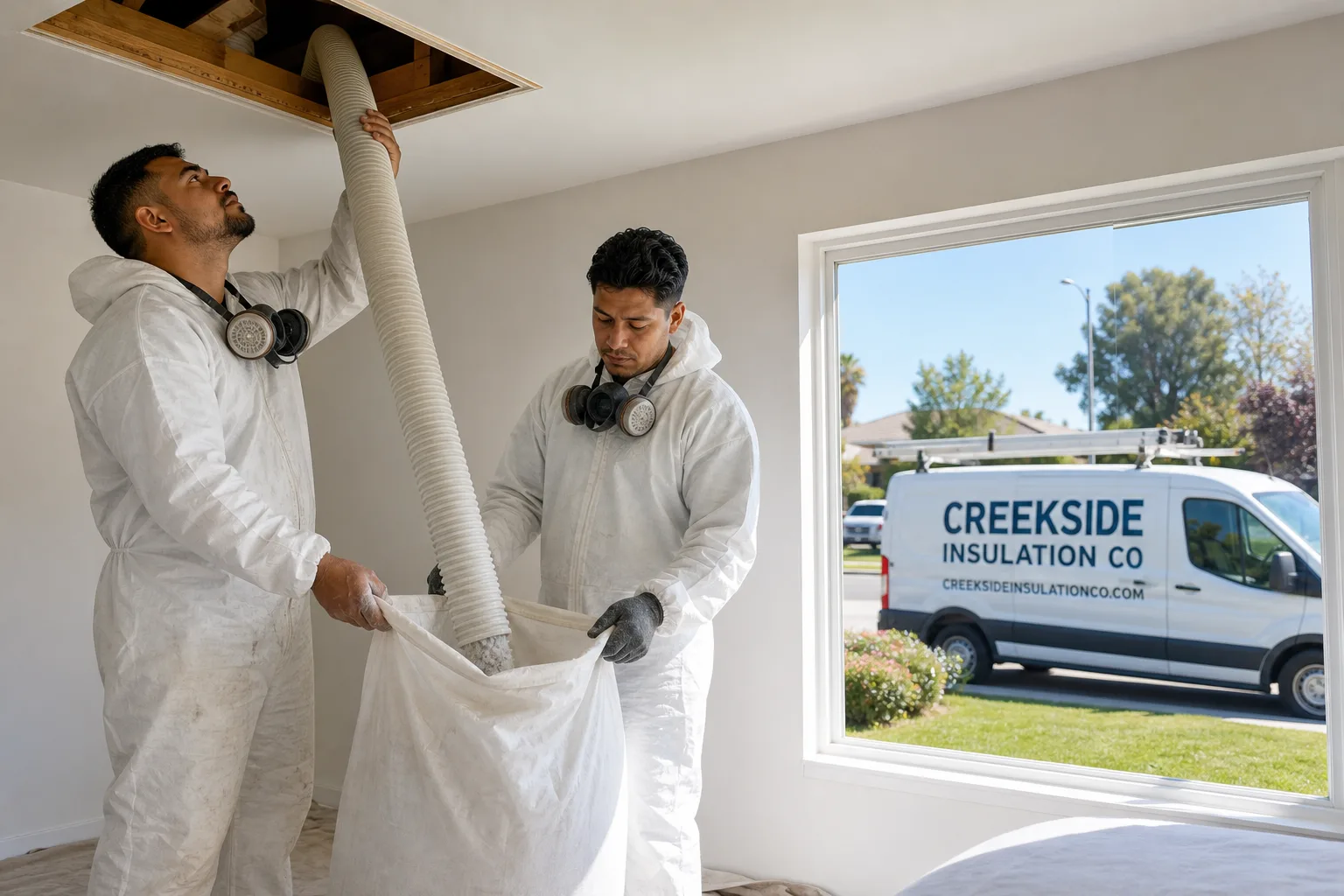
Fast, Reliable Spray Foam Insulation Across La Habra Heights
Spray foam insulation in La Habra Heights typically runs $2.75 – $6.50 per board foot installed, and most custom-home projects here land between $4,800 and $14,200 depending on the assembly. We know the hillside lots off Hacienda Boulevard, the winding lanes above West Road, and the equestrian properties back toward the Puente Hills. When you call Creekside Insulation Co at (844) 948-3251, you’ll reach a crew that understands what La Habra Heights homes actually demand: vaulted beam ceilings, detached outbuildings, and a county permit path that rewards careful detailing. We respond to La Habra Heights calls same day for foam estimates.
Why Creekside Insulation Co Is La Habra Heights’s Preferred Spray Foam Insulation Company
Most La Habra Heights customers come to us because their home isn’t a tract house and the standard insulation pitch doesn’t fit. A ranch home with cathedral ceilings above a great room needs a different approach than a split-level with a conventional attic, and a tack room or hay barn is a separate assembly entirely. We carry Icynene and Demilec foam lines, which means we can spec open-cell or closed-cell based on what the roof deck, rafter bays, and ember-hardening goals ask for. The hillside wind here is real. Cooler nights at elevation pull heat out of homes faster than flatland owners realize, and a roof assembly that leaks conditioned air costs more every month than most people assume.
Noel Ibarra, our owner, has built the company around one idea: the right insulation is whatever your home actually needs. Not a default product, not a brand we’re trying to move. Eight brands, one honest recommendation. That’s the whole approach.
La Habra Heights homeowners tell us the same thing after the job: they didn’t know their home could hold temperature this evenly. We take that as the standard, not a bonus.
Spray Foam Attic Insulation in La Habra Heights
Spray foam attic insulation in La Habra Heights often means insulating a roof deck, not blowing into a floor. Many homes here have vaulted open-beam ceilings over living spaces with no conventional attic cavity at all. When there is an attic, the job is straightforward: we air-seal the ceiling plane or spray the underside of the roof deck to stop conditioned air from escaping. When there isn’t one, we spray directly to rafter bays from below and cap as needed to preserve the look of exposed woodwork. Typical attic foam work in La Habra Heights runs $2,800 – $7,900 for open-cell on a standard ranch attic, and $5,200 – $12,500 for closed-cell roof-deck assemblies on vaulted sections.
Roof Deck Applications for Vaulted Ceilings
On a vaulted open-beam great room off a hillside lane near Hacienda Boulevard, our crew couldn’t blow into an attic because there wasn’t one. We sprayed closed-cell foam directly to the rafter bays from below, then capped with rigid board to keep the exposed beams visible. The homeowner wanted the beams and Spanish-tile character intact while cutting the wind-driven heat loss that comes with the hilltop elevation. The finished assembly did both without burying the woodwork.
Air Sealing the Attic Floor
Homes that do have a conventional attic in La Habra Heights still lose the most conditioned air through the ceiling plane. Open-cell foam across the attic floor seals penetrations, recessed light housings, and the gaps around plumbing stacks. This works well on ranch homes where the attic is accessible and the roof deck has proper venting.
Spray Foam Wall Insulation in La Habra Heights
Spray foam wall insulation in La Habra Heights is usually retrofit work on exterior walls, rim joists, or the band joist area where unconditioned air sneaks in at the floor line. Older custom homes here were often built with minimal wall cavity insulation, and the hilltop wind finds every gap. We install open-cell foam in existing wall cavities through small access holes, and closed-cell foam at rim joists and crawlspace boundaries where moisture and wind pressure are higher. Wall cavity foam in La Habra Heights typically runs $1,900 – $5,700 per exterior wall section depending on access and cavity depth, while rim joist work runs $900 – $2,400 for most hillside homes.
Rim Joist and Crawlspace Sealing
The rim joist is where the foundation meets the framing, and on hillside homes this area faces real wind pressure. Closed-cell foam here stops drafts at the source and keeps crawlspace air from pulling into living space. We approach this as its own assembly, not an add-on.
Garage and Outbuilding Walls
Detached garages, workshops, and guest houses in La Habra Heights often have unfinished wall cavities. We spray those separately from the main house, since they have different heating, cooling, and moisture profiles than living space.
Trusted Brands We Service in La Habra Heights
Our Spray Foam Insulation crews install Icynene and Demilec open- and closed-cell foams, and we also carry Owens Corning, Johns Manville, and GreenFiber product lines for hybrid jobs where foam is paired with other materials. For La Habra Heights jobs that call for fire-rated detailing or sound attenuation around a home theater or guest suite, we keep Rockwool on the truck as well. The point of carrying eight brands isn’t to confuse the bid. It’s so the recommendation matches what the house needs. If your home needs closed-cell foam on a roof deck and Rockwool in a partition wall, we don’t have to stretch one product to do both jobs.
Common Spray Foam Insulation Problems We See in La Habra Heights Homes
- Cathedral ceilings with no attic cavity. A standard blow-in bid doesn’t work on these homes. The right fix is spraying the rafter bays directly, and it has to be detailed so moisture doesn’t get trapped against the roof deck under the Spanish tile.
- Detached stables and tack rooms lumped into the house bid. These are separate assemblies. A tack room needs its own air sealing and moisture control, and a hay barn is a ventilation question before it’s an insulation question. We bid and detail them separately.
- Santa Ana wind season ember intrusion. Wind-driven embers get into attic vents and eave gaps. Foam applied without ember-resistant detailing and correct venting can undermine the fire-hardening the homeowner asked for. We sequence foam work with venting and ember protection as one assembly, not two trades.
- Hilltop wind and cold nights driving heat loss. Homes at La Habra Heights elevation lose more heat through the roof and rim joist than flatland homes of the same size. If a room feels drafty only on windy nights, the problem is usually the rim joist or an unsealed eave, not the HVAC.
Pricing for Spray Foam Insulation in La Habra Heights, CA
Here’s what we’re seeing in the La Habra Heights market right now. Open-cell attic floor foam on a standard ranch attic runs $2,800 – $5,400. Closed-cell roof deck foam on vaulted sections runs $5,200 – $12,500 depending on square footage and how much scaffolding or ladder work the hillside slope requires. Rim joist sealing runs $900 – $2,400. Wall cavity foam runs $1,900 – $5,700 per major wall section, and detached outbuildings are bid as their own line item. What moves the number most: roof deck access, cathedral ceiling square footage, and whether we’re working around exposed beams that can’t be covered. Call (844) 948-3251 for an exact quote. Estimates are free, and we’ll walk the assembly with you before we ever write a number.
We Also Serve Cities Near La Habra Heights
Our crew regularly works Spray Foam Insulation in La Habra Heights and the surrounding communities, including La Habra, East La Mirada, Fullerton, and La Mirada. If you’re on the edges of 90633 or just over the county line, we’re already working nearby and can usually schedule an estimate within the same week.
Serving La Habra Heights, CA — Our Local Coverage Area
We’re based in the La Habra Heights area and know this community well. Use the map below to see our service coverage — if you’re nearby, we can almost certainly help.
FAQs About Spray Foam Insulation in La Habra Heights
Yes. The standard approach is spraying closed-cell foam directly to the rafter bays from below, then capping with a rigid board so the foam sits tight against the roof deck and the exposed beams stay fully visible. We’ve done exactly this on hillside homes where the beams and tile character are part of the house’s value. The detail work matters: the foam has to be applied in lifts so it doesn’t sag or bulge against the beam edges. Call (844) 948-3251 and we’ll look at your ceiling before recommending anything.
La Habra Heights is unincorporated, so most spray foam projects are permitted through LA County rather than a city building department. County inspectors here look hard at attic venting and ember-resistant detailing, especially on cathedral-ceiling homes where there’s no conventional attic. We sequence foam work with that scrutiny in mind from the first walkthrough.
Yes, we bid and detail detached stables, tack rooms, workshops, and hay barns as their own assemblies. A tack room has different moisture and air-sealing needs than living space, and a hay barn is mostly a ventilation question. You’ll get separate line items, not a single number that assumes everything gets the same foam.
Wind at La Habra Heights elevation puts more pressure on rim joists and eave gaps than flatland homes experience, and cooler nights pull heat through roof decks faster. That pushes us toward closed-cell foam more often on roof decks and rim joists than we’d spec on a flatland tract home. Thickness gets matched to the assembly, not pulled from a generic chart.
We install Icynene and Demilec open- and closed-cell foams, and we carry Owens Corning, Johns Manville, and GreenFiber for hybrid jobs where foam pairs with other materials. For fire-rated or sound attenuation work we keep Rockwool on hand. The brand follows the need, not the other way around. Call (844) 948-3251 for a free estimate and we’ll spec your home based on what’s actually in it.
Written by Noel Ibarra, Owner at Creekside Insulation Co, serving La Habra Heights and surrounding hillside communities with spray foam, attic, and blown-in insulation.