Fast, Reliable Attic Insulation Across Whittier
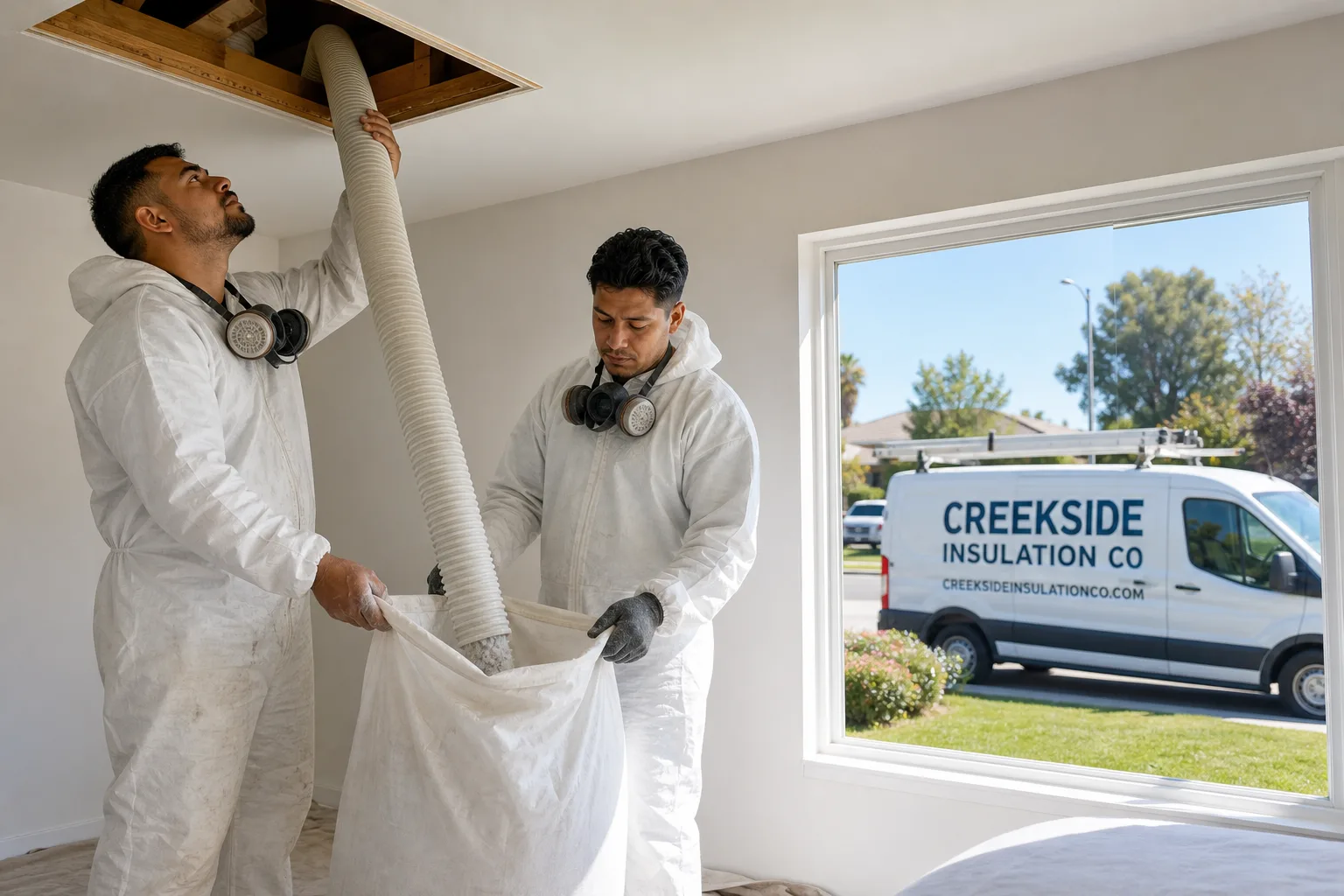
Attic insulation in Whittier typically runs $1,800 – $4,600 for a full retrofit on a 1,200 – 1,800 sq ft home, with blown-in fiberglass or cellulose landing on the lower end and spray foam or radiant barrier add-ons pushing toward the top. Most Whittier jobs take one day, and we schedule within 3 – 5 business days for standard work. If your summer cooling bills have crept up year after year or the upstairs rooms in your 1950s tract home never quite cool down, the attic is usually where the problem starts. Creekside Insulation Co has worked in attics across Uptown, Friendly Hills, East Whittier, and South Whittier long enough to know exactly what’s hiding above the ceiling in this city’s homes. Call (844) 948-3251 and we’ll give you a straight answer about what your attic actually needs.
Why Creekside Insulation Co Is Whittier’s Preferred Attic Insulation Company
We’re a specialist, not a general contractor dabbling in insulation. That matters in Whittier because the housing stock here has a very specific set of problems: 1950s – 60s open-eave attics, original recessed can lights, unsealed top plates, and blown fiberglass that has compressed over decades of 140°F+ summer attic heat. A crew that only does new construction won’t recognize half of what we see up there. We carry eight manufacturers across all four major insulation types: fiberglass (Owens Corning, Johns Manville, CertainTeed, Knauf), mineral wool (Rockwool), open- and closed-cell spray foam (Icynene, Demilec), and recycled cellulose (GreenFiber). That breadth means our recommendation is driven by what your home’s conditions actually call for, not what happens to be loaded on our truck. For Attic Insulation work in Whittier, we bring the same crew, the same standards, and the same honest product matching to every job, whether it’s a compact stucco tract home in the 90601 zip or a larger hillside property in Friendly Hills. Noel Ibarra has built the company around one principle: match the material to the house, not the house to the material.
Attic Ventilation in Whittier
Attic Ventilation work in Whittier usually means correcting what 1950s – 60s construction never had: adequate intake at the eaves and exhaust near the ridge so hot air can actually leave instead of baking the insulation and radiating down into your living space. On a typical single-story tract home here, we’re installing or clearing soffit vents, adding baffles to keep insulation from blocking airflow, and often upgrading passive exhaust. Most Whittier homeowners don’t realize their attic ventilation is failing until we show them the compressed fiberglass and heat-damaged decking, signs that the attic has been cooking at 140°F+ every summer. A full ventilation correction on a Whittier home runs roughly $600 – $1,800 depending on attic size and how much baffle work is needed, and it should be done before or alongside any insulation upgrade, because fresh insulation can’t perform at rated depth if the attic can’t breathe.
Open-Eave Venting Repairs
The open-eave construction common across Whittier’s 1940s – 1960s tracts has a built-in flaw: the eave openings that were meant to feed outside air into the attic are often blocked by old insulation or were never sized right in the first place. We see this constantly in South Whittier and the neighborhoods around Whittier College, where attics run 20 – 30°F hotter than they should even on mild days. Correcting it means clearing the intake path, adding baffles against the roof deck, and sometimes installing additional vents.
Attic Baffles and Airflow
Without baffles, blown insulation drifts right up against the roof deck and chokes off the air channel, which is exactly what we found on a Friendly Hills property where the fiberglass had matted flat against the low-pitch decking. We install baffles at every rafter bay to protect the intake air path, then blow insulation to full depth over the ceiling plane, not the roofline. It’s a small part that makes a big difference in how well the whole system works.
Radiant Barrier in Whittier
Radiant Barrier in Whittier is one of the highest-value measures you can add to an attic, because this city sits in the inland Los Angeles basin where summer attic temperatures routinely exceed 140°F and radiant heat gain through the roof accounts for the majority of your cooling load. A radiant barrier, typically stapled to the underside of the roof deck, reflects that heat back out before it ever reaches the insulation or the ceiling below. On Whittier’s low-pitch roofs, which absorb full sun from mid-morning to late afternoon, we’ve seen attic temperatures drop 20 – 30°F after a proper radiant barrier installation. Radiant barrier work in Whittier generally runs $1,200 – $2,800 for an average single-story home, and it pairs exceptionally well with air sealing and blown-in insulation, because the barrier handles the radiant component while the insulation handles conduction and convection.
Under-Deck Radiant Barrier
We attach the barrier directly to the roof deck, leaving the air gap that’s required for it to work. Whittier’s open-eave attics are well suited to this because the existing venting gives the reflected heat somewhere to escape. We also ensure the barrier doesn’t trap moisture against the deck framing, which matters more in this climate than people assume.
Radiant Barrier with Insulation Top-Up
When a Whittier home still has the original thin fiberglass or, worse, compressed matted insulation, we often recommend pairing the radiant barrier with an insulation top-up to bring the attic up to R-38 or better. The barrier stops the radiant heat, and the fresh insulation slows whatever conductive heat remains. Together they drop cooling bills more than either measure alone.
Trusted Brands We Service in Whittier
Because we’re authorized to install products from eight manufacturers, we can match the material to what your Whittier attic actually needs rather than pushing one brand on every job. We regularly install GreenFiber recycled cellulose for homeowners who want high recycled content without giving up thermal performance, Owens Corning fiberglass for attic top-ups and full re-insulation, and Johns Manville where a dense, consistent blown-in layer suits low-pitch roofs. For spray foam work, we use Icynene and Demilec open- and closed-cell formulations, which handle airtight sealing and moisture control far better than batts in certain attic configurations. Keeping several trusted brands in our local supply chain also means faster turnaround for Whittier customers, because we’re not waiting on a single manufacturer’s distribution schedule.
Common Attic Insulation Problems We See in Whittier Homes
- Compressed blown fiberglass in low-pitch attics. Whittier’s 1950s – 60s tract homes have shallow roof pitches, and older blown fiberglass often ends up matted flat against the roof deck instead of staying at full depth over the ceiling. That cuts its effective R-value roughly in half, which is why so many attics here feel far hotter than they should.
- Open-eave venting blowing dust and debris into the attic. Decades of Santa Ana winds and open eave construction means dust, pollen, and even light debris accumulate on top of older insulation, contaminating it and speeding up compression. We routinely find insulation that looks eight inches deep but performs like three.
- Unsealed recessed can lights and top plates leaking conditioned air. In mid-century Whittier tracts, the original recessed cans and the gaps around top plates were never sealed, so hot attic air pours into the living space even after new insulation is blown in. Skipping air sealing on a retrofit is the single most common reason insulation upgrades underperform here.
- Radiant heat gain through minimally insulated attics in Friendly Hills and east Whittier custom homes. These larger homes were built with the same minimal attic insulation as the smaller tracts, but their bigger roofs absorb more sun. The result is upstairs rooms that run 8 – 12°F warmer than downstairs in summer, even with the AC running constantly.
Pricing for Attic Insulation in Whittier, CA
Whittier attic insulation pricing breaks down roughly like this: a blown-in fiberglass or GreenFiber cellulose top-up on a 1,200 sq ft home runs $1,800 – $2,800; a full remove-and-replace with air sealing in a 1,500 – 1,800 sq ft home lands between $3,200 – $4,600; radiant barrier adds $1,200 – $2,800 depending on attic size and deck complexity; and attic ventilation correction runs $600 – $1,800. Homes in Friendly Hills or the larger east Whittier custom properties with more complex rooflines and multiple attics or cathedral sections will land toward the higher end. What moves the number is attic square footage, whether old insulation needs to be removed, and how much air sealing is required. We give free estimates with exact numbers before any work starts, so you’ll never get a vague range and a surprise later. Call (844) 948-3251 to schedule a walkthrough.
We Also Serve Cities Near Whittier
We regularly work in Attic Insulation in Whittier and the surrounding communities, including South Whittier, West Whittier-Los Nietos, East La Mirada, and Santa Fe Springs. Most of these neighborhoods share the same mid-century housing stock and open-eave attic conditions we know so well, which means we can diagnose and quote faster than a crew that doesn’t know the territory. If you’re just across the city line, call us and we’ll let you know when we can get there.
Serving Whittier, CA — Our Local Coverage Area
We’re based in the Whittier area and know this community well. Use the map below to see our service coverage — if you’re nearby, we can almost certainly help.
FAQs About Attic Insulation in Whittier
Because the overwhelming majority of Whittier’s housing stock was built between the 1940s and 1960s, long before California’s Title 24 energy standards existed, those homes originally got little or no attic insulation. New construction here is rare, mostly infill or a hillside custom home here and there, so the insulation work in this city is almost always removing, topping up, or replacing what a mid-century home underperforms with today. Call (844) 948-3251 and we’ll tell you what your specific attic is working with.
We typically find original blown fiberglass that has compressed against the low-pitch roof deck, unsealed recessed can lights, and top plates that were never air-sealed, all of which let hot attic air pour into the conditioned space below. We also see dust and debris from decades of open-eave venting that has contaminated the insulation and cut its effective R-value. The good news is all of it can be corrected in a day or two with the right materials and methods.
Because Whittier sits in the inland LA basin where the dominant comfort problem is attic radiant heat and cooling load, not cold-weather heat loss. Attic temperatures here routinely hit 140°F+ in summer, and a radiant barrier stops that heat before it ever gets into the insulation or your ceiling, which wall insulation can’t do. It’s the single highest-value retrofit for a Whittier attic, and it works best paired with air sealing and a blown-in top-up.
We treat them as retrofit projects where restoring lost R-value matters as much as adding new, because those larger custom homes were built with the same minimal attic insulation as the smaller tract houses but have much bigger roof surfaces absorbing sun. We air-seal the top plates and can surrounds, restore proper attic ventilation, and blow insulation to R-38 or better, often adding a radiant barrier under the decking. The goal is the same as any Whittier home: keep conditioned air where you paid to put it.
We install products from eight manufacturers across all four major insulation categories, including Owens Corning and Johns Manville fiberglass, GreenFiber cellulose, Rockwool mineral wool, and Icynene and Demilec spray foam. That means the brand we recommend for your Whittier home depends on your attic’s construction, venting, and your performance priorities, not on what we happen to stock. Call (844) 948-3251 for a free estimate and we’ll give you an honest product recommendation based on what your home actually needs.
Written by Noel Ibarra, Owner at Creekside Insulation Co, serving Whittier and surrounding communities with attic insulation, spray foam, and blown-in work since our first attic retrofit here.