Fast, Reliable Attic Insulation Across South San Jose Hills
Attic insulation in South San Jose Hills usually means a retrofit, not a new build. Most homes here are 1950s to 1970s stucco tract houses sitting on slab foundations, and their attics still hold the original builder-grade R-11 batts, now compressed flat under decades of settled dust. We replace that underperforming layer with materials matched to your home’s actual conditions, not a default product. Call (844) 948-3251 and we’ll have a crew out to your South San Jose Hills home, usually within one business day for an assessment.
The heat here is the real problem. Summer afternoons in the mid-90s to low 100s push attic temperatures past 130 degrees, and a thin layer of old fiberglass stops almost none of that from radiating into your living space. That’s why we approach every attic insulation job in South San Jose Hills as a two-part fix: clean and air-seal first, then add R-value. Anything less just traps heat under fresh insulation.
Why Creekside Insulation Co Is South San Jose Hills’s Preferred Attic Insulation Company
We’ve spent enough time in South San Jose Hills attics to know what’s up there before we even lift the hatch. The grey grit layer is the tell. Homes in the 91792 tract sit directly against the City of Industry’s warehouse corridors and truck routes, and that industrial dust settles into attic insulation in a way you won’t see in nearby Walnut or Rowland Heights. We carry that local knowledge into every estimate, because it changes how we sequence the work.
Noel Ibarra runs our crews, and he has a simple rule for South San Jose Hills jobs: don’t blow new insulation over a dirty attic. That’s not a sales pitch. It’s the difference between an insulation retrofit that actually lowers your cooling bill and one that just buries a problem. Homeowners who have lived in South San Jose Hills for twenty years recognize the difference in how their upstairs rooms feel by the first hot afternoon after we finish.
When you call, you get a straight answer about what your attic needs and what it doesn’t. We don’t push a single brand or a single material, because we install eight of them, including Owens Corning, Johns Manville, and Rockwool. That breadth means our recommendation is based on your roof pitch, your existing ventilation, and the condition of what’s already up there. If your attic only needs a top-up, we’ll say so.
Attic Ventilation in South San Jose Hills
Attic ventilation in South San Jose Hills is often the missing half of the insulation equation. Many of these low-pitch tract roofs have minimal soffit venting, which means heat collects and sits under the roof deck instead of flushing out. When ventilation is inadequate, added insulation can’t hold a temperature differential, and a radiant barrier loses much of its benefit. We inspect venting before recommending any R-value upgrade, because on these homes, the two decisions are connected.
Soffit and Roof Deck Airflow
Low-pitch roofs leave less room for air to move from soffit to ridge, so we often add baffles to keep insulation from blocking the intake path. On 1950s and 1960s homes in South San Jose Hills, original soffit vents are frequently undersized or painted over during past exterior work. Restoring that airflow is a prerequisite for any meaningful attic insulation improvement here.
When Ventilation Work Makes Sense
If your upstairs rooms stay hot well into the evening after the sun drops, or if you see condensation staining on the underside of the roof sheathing, ventilation is probably part of the problem. We’ll factor venting improvements into the attic insulation estimate, and the cost for adding baffles and clearing blocked soffits typically runs $300 to $700 depending on roof access and vent condition.
Radiant Barrier in South San Jose Hills
Radiant barrier in South San Jose Hills earns its keep during the long inland summer, when roof deck temperatures climb past 130 degrees and radiate heat downward into the living space. A radiant barrier installed on the underside of the roof deck reflects a significant portion of that heat back out, which reduces the load on your AC. In this climate, cooling performance dominates the insulation calculation, so we recommend radiant barrier more often here than in coastal communities.
Why Low-Pitch Roofs Need Careful Placement
On a low-pitch roof, radiant barrier placement matters more than on a steep roof, because the material sits closer to the ceiling and any installation errors show up as hotspots. We install it with an air gap facing the roof deck, which is what makes it work. Properly installed, a radiant barrier in a South San Jose Hills attic can reduce heat gain through the ceiling by a noticeable margin during peak afternoon hours.
Radiant Barrier and New Insulation Together
The best results come when radiant barrier and blown-in insulation are installed as a coordinated job. The barrier cuts radiant heat transfer, while the insulation slows conductive gain. For a typical 1,200 to 1,600 square foot South San Jose Hills home, adding radiant barrier alongside attic insulation runs roughly $1,800 to $3,400, depending on roof geometry and access.
Trusted Brands We Service in South San Jose Hills
We install products from Owens Corning, Johns Manville, and Rockwool, among others, and we keep the materials common to South San Jose Hills jobs stocked so there’s no delay between estimate and install. That includes GreenFiber loose fill for top-ups over settled batts, and Rockwool batts for homeowners who want fire resistance along with thermal performance. If you’ve been told your only option is one specific product, get a second look, because we carry enough brands to match the material to your home rather than matching your home to whatever’s on the truck. Call (844) 948-3251 and we’ll explain the options in plain terms.
Common Attic Insulation Problems We See in South San Jose Hills Homes
- Compressed R-11 batts that stopped insulating years ago. The original fiberglass in most 91792 homes is barely above R-11 when new, and after decades of dust settling, foot traffic, and gravity, it sits flat at a fraction of that. The labeled R-value is a fiction long before anyone notices the heat.
- Industrial dust turning insulation into a grey silt layer. The adjacent City of Industry warehouses and truck corridors put a fine particulate into the air that settles in attics across South San Jose Hills. That grit holds heat and defeats whatever insulating value the material still has.
- Leaky attic hatches and recessed can lights. Builder-grade attic hatches in these 1960s-era homes rarely seal tight, and original recessed lights act like open chimneys into a 130-degree attic. Air-sealing these penetrations is a small job with an outsized effect on room comfort.
- Minimal soffit venting on low-pitch roofs. Many original roofs here simply don’t have enough intake vent area, so heat builds and lingers. Even a properly insulated attic can bake a second story when the airflow can’t flush the heat out during the evening.
Pricing for Attic Insulation in South San Jose Hills, CA
A full attic insulation replacement in South San Jose Hills typically runs $2,200 to $4,800 for an average single-story tract home, depending on square footage and whether we’re also adding radiant barrier or ventilation work. A top-up over existing settled insulation runs $1,100 to $2,300, and that’s a practical option for homeowners who don’t want to pay for removal. Attic batt replacement for smaller homes and vaulted sections often lands between $1,500 and $3,000. If the attic has pest damage or moisture-rotted decking, those repairs add cost, and we’ll flag them during the estimate rather than after the crew arrives. Estimates are free, and the quote you get is the number on the invoice unless you add scope.
Call (844) 948-3251 for a site-specific number. We serve all of the South San Jose Hills area, including homes off Fairgrove Avenue and the residential pockets along Valley Boulevard.
We Also Serve Cities Near South San Jose Hills
Our Attic Insulation team regularly works in the communities surrounding South San Jose Hills, including Valinda, Walnut, Rowland Heights, and La Puente. If you live in one of those cities and need the same dust-aware, ventilation-first approach we bring to South San Jose Hills attics, call (844) 948-3251 and we’ll schedule you in.
Serving South San Jose Hills, CA — Our Local Coverage Area
We’re based in the South San Jose Hills area and know this community well. Use the map below to see our service coverage — if you’re nearby, we can almost certainly help.
FAQs About Attic Insulation in South San Jose Hills
That grey layer is industrial particulate from the City of Industry’s warehouse and truck corridors that sit directly against South San Jose Hills. It settles through vents and gaps over years and embeds into attic insulation, where it holds heat and compresses the material. Homes in neighboring foothill communities don’t usually see this, which is why we treat every South San Jose Hills attic as a two-part job: clean and air-seal the decking, then add new insulation. Call (844) 948-3251 and we’ll assess how much of that dust has settled into your attic.
Yes, and it’s one of the highest-return improvements you can make in the South San Jose Hills climate. Original R-11 batts are functionally near zero when compressed flat under decades of settled grit, and your cooling system is fighting a losing battle against a 130-degree attic every summer afternoon. Upgrading to a modern R-38 or better, with air-sealing and ventilation restored, typically pays back through reduced cooling costs and a noticeably more comfortable upstairs. We’ll give you straight numbers during the estimate.
Install the radiant barrier and new insulation in the same job, with the barrier placed on the underside of the roof deck before the insulation is blown in or installed. On a low-pitch roof, the sequence matters because access becomes tight once insulation is in place. We coordinate both so you’re not paying twice for the same attic access.
Blown-in fill can be added over old settled batts in some cases, but we don’t recommend it in South San Jose Hills without first removing or cleaning the dust-laden original material. The industrial grit layer undermines performance and creates an uneven base. We’ll tell you whether removal is needed after we see the condition of what’s up there, and we’ll price both paths honestly.
Title 24 energy standards apply to new construction and some remodel scopes in California, but a voluntary insulation retrofit in an existing South San Jose Hills home doesn’t trigger a compliance mandate. However, matching your attic to the performance intent of Title 24, roughly R-38 to R-49 depending on the zone, is the practical benchmark for genuine comfort improvement here. We size recommendations to your roof and venting, not just the code minimum. Call (844) 948-3251 for a free estimate that’s specific to your home.
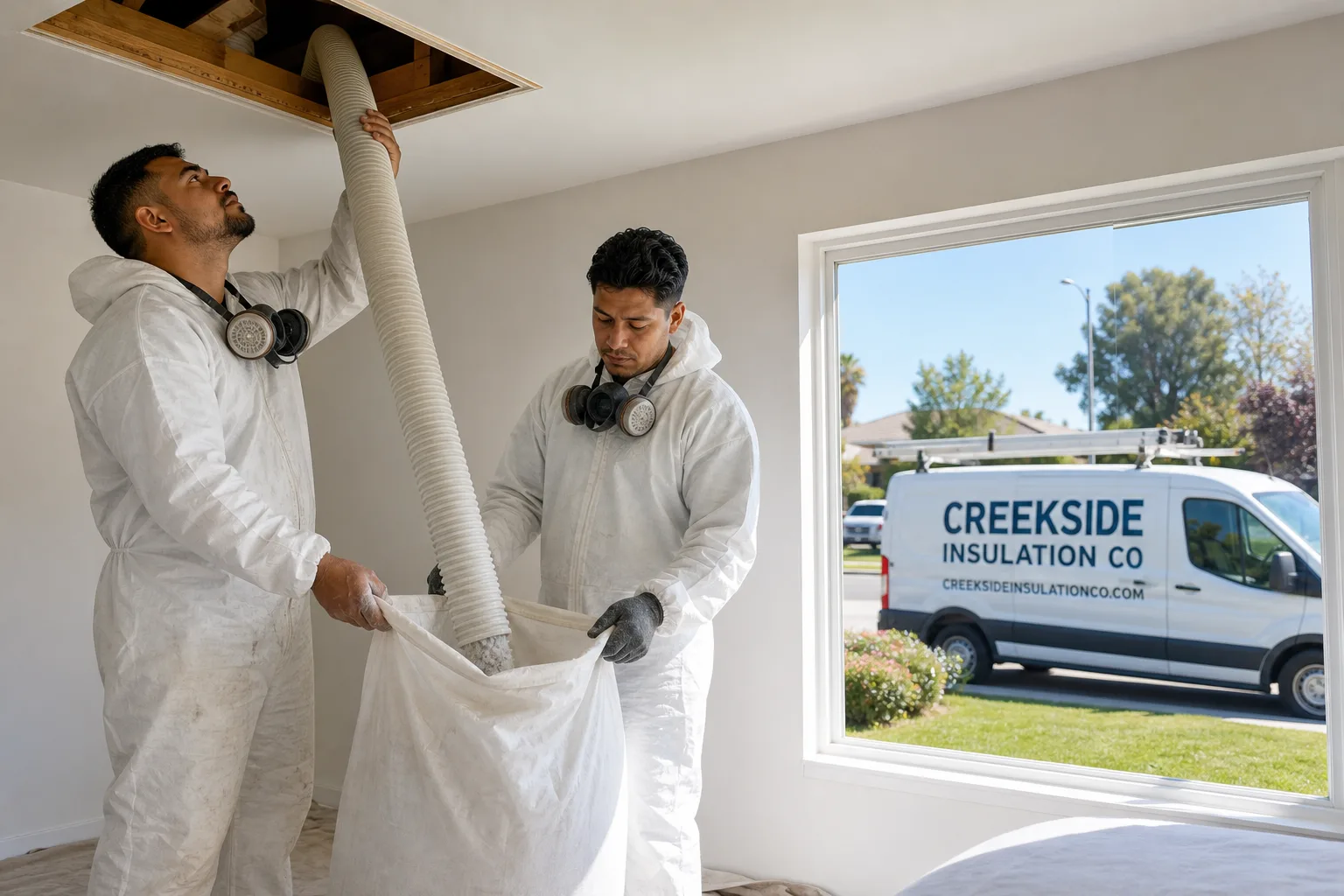
On a low-pitch stucco tract home off Fairgrove Avenue in the 91792 tract, our crew pulled out builder-grade R-11 batts that had compressed flat under decades of grey settled grit from the Industry warehouses next door. After air-sealing the top plates and vacuuming the decking, we blew in GreenFiber loose fill to bring the attic up to modern R-value and added a radiant barrier, and the upstairs rooms that used to cook through August afternoons finally held their set temperature. That’s the standard we bring to every attic insulation job in South San Jose Hills.
Call (844) 948-3251 and Noel Ibarra or one of our project leads will schedule your free attic assessment. We’ll show you what’s up there, explain what it needs, and give you a number you can hold us to.
Written by Noel Ibarra, Owner at Creekside Insulation Co, serving South San Jose Hills attics from the Inland Valley to the 91792 tract.