Fast, Reliable Attic Insulation Across South Gate
Attic insulation in South Gate typically costs $1.80 to $3.90 per square foot installed, depending on material and the condition of what’s already up there. Most jobs in the 90280 zip code take one to two days, and we can usually start within a week of your call. If your home off Firestone Boulevard or near South Gate Park feels like it never quite cools down in August, the attic is almost always where we’d look first. Call (844) 948-3251 for a straight answer and a free estimate.
We know the housing stock here because we’ve spent years working inside it. The post-WWII stucco tracts that fill South Gate were built fast, with single-wall construction and whatever insulation was cheap at the time. That means most attics we step into along Tweedy Boulevard, Long Beach Boulevard, or the neighborhoods around Hollydale have either nothing up there or a thin layer of rock wool or fiberglass that’s been compacted flat for decades. The result is predictable: furnace heat pours in through the ceiling all afternoon, and your AC works overtime trying to fight it. We fix that at the source.
Why Creekside Insulation Co Is South Gate’s Preferred Attic Insulation Company
We’re not the biggest insulation shop in the LA Basin, and that’s intentional. Creekside Insulation Co is built around one thing: knowing which insulation actually belongs in your specific attic. We carry eight brands across all four major material types, so the recommendation you get is driven by what your home needs, not what we happen to have sitting in the warehouse. For a 1950s South Gate tract house with settled batts and freeway noise, that might mean GreenFiber cellulose blown deep and even. For a converted garage with awkward framing, it might mean Demilec closed-cell spray foam. The honest answer comes from looking at your attic, not from a sales script.
Led by Noel Ibarra, our crew has worked attics from Lynwood to Bell, and we know the specific quirks of South Gate’s older homes: the knob-and-tube wiring, the narrow side yards, the additions that were never insulated when they were built. That local familiarity means we show up prepared, not surprised. Homeowners in South Gate keep hiring us because we treat legacy wiring with the respect it demands, we don’t cut corners on air sealing, and we leave the job cleaner than we found it. When you call, you’re talking to people who know exactly what your street looks like.
Attic Insulation Removal in South Gate
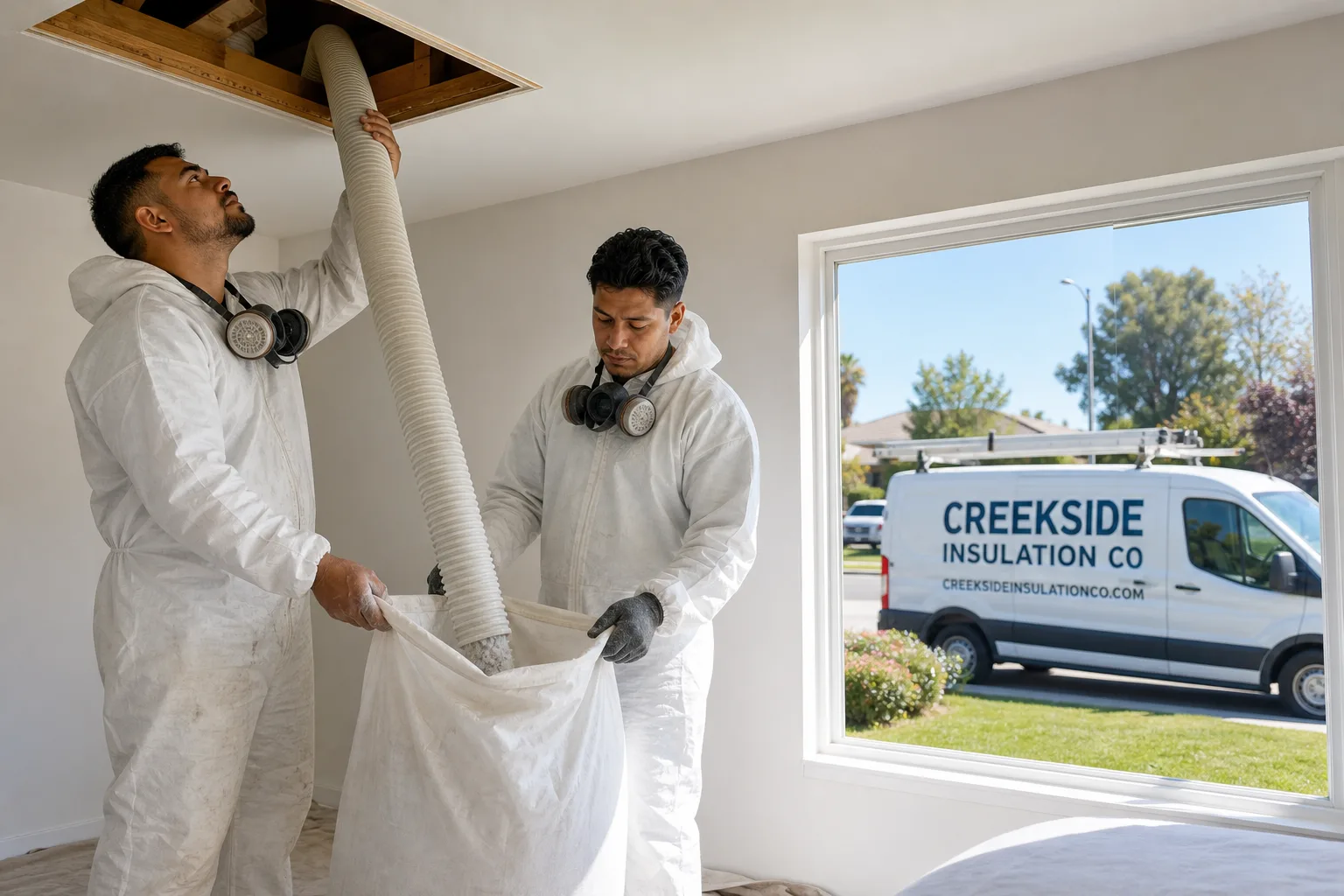
Attic Insulation Removal in South Gate is a job we do constantly, because most of the insulation in these 1940s and 1950s homes has outlived whatever usefulness it once had. Original batts settle, compact, and hold dust, rodent debris, and decades of whatever filtered through the vents. In a 90280 attic that’s been baking at 130-plus degrees every summer, that material isn’t doing much beyond sitting there. Removal involves vacuuming out the old insulation down to the ceiling joists, inspecting what’s underneath, and preparing the attic for new material. For a typical 1,000 to 1,200 square foot attic in South Gate, removal alone usually runs $1.20 to $2.10 per square foot, with the price coming down when bundled with new insulation.
Working Around Legacy Wiring
Many South Gate homes still have knob-and-tube or early romex wiring running through the attic. Removal crews have to be careful, methodical, and willing to stop and flag anything that doesn’t look right. We never pull insulation blindly around old wiring, and we’ll tell you plainly if something up there needs an electrician’s attention before we proceed.
When Old Insulation Has to Go
You don’t always need removal. If the existing material is dry, reasonably clean, and just a bit thin, a top-up might be enough. But if we find evidence of rodents, water staining, or insulation that’s compacted to half its original depth, removing it first is the only way to get a real result. In South Gate’s tight roof cavities, leaving degraded material in place just traps the heat problem you’re trying to solve.
Insulation Contractors in South Gate
Insulation Contractors in South Gate are not all the same, and we’d encourage any homeowner here to ask hard questions before hiring one. The main division is between general contractors who insulate on the side and specialists who think about thermal boundaries, air movement, and material compatibility every day. Creekside Insulation Co falls squarely in the second camp. Our work in South Gate focuses on the three highest-impact applications: Attic Insulation, spray foam, and blown-in. We handle the full scope ourselves, no subcontractors, which means the same crew that air-seals your ceiling plane is the one blowing in the final blanket.
Air Sealing Before You Insulate
In a 1950s South Gate house, the attic floor is usually riddled with gaps: around plumbing penetrations, recessed light cans, chimney chases, and the cracks where walls meet the ceiling. Blowing insulation over those gaps doesn’t stop hot air from leaking through. We seal the ceiling plane first with proper materials, then insulate. It’s an extra step most crews skip, and it’s the difference between an attic that’s insulated and an attic that’s actually working.
Access in Tight Lots
South Gate’s dense tract layout means side yards are often three or four feet wide, and there’s no path to get a blower hose around the back. We stage equipment in the driveway or street and run the hose through a window or door, protected and clean. It’s slower and more deliberate than the wide-open suburban jobs, but it’s the only way to do the work properly here, and we’ve done it dozens of times.
Trusted Brands We Service in South Gate
Because we’re material-agnostic, we stock and install a roster of products most South Gate insulation companies can’t offer. If your attic calls for fiberglass, we work with Owens Corning, Johns Manville, and Knauf. If fire resistance or sound attenuation matters, because your house backs up to the 710 or sits under the flight path, Rockwool is on our truck. If you want recycled content and dense coverage, GreenFiber cellulose is a standard option. And for open-cell or closed-cell spray foam, we install Icynene and Demilec. Eight brands, one honest recommendation. We keep common materials local and can turn around even large South Gate jobs without long waits for special orders.
Common Attic Insulation Problems We See in South Gate Homes
- Settled and compacted original batts. The fiberglass or rock wool installed when these tract homes were built has been crushed flat under its own weight. What remains is maybe an inch thick, leaving R-values in the single digits.
- Knob-and-tube wiring inside the insulation. Many 90280 attics still carry the original cloth-wrapped wiring, and loose-fill insulation piled over it creates a genuine fire safety concern. Insulation around these circuits has to be handled with care, not buried blindly.
- Converted garages and additions with zero insulation. South Gate’s dense lots pushed a lot of families to enclose garages and build add-ons. These spaces usually lack any ceiling insulation at all, making them the hottest rooms in the house by a wide margin.
- Freeway and rail noise bleeding through the ceiling. Homes near the 710 and 105 corridors deal with constant ambient noise. A properly insulated and air-sealed attic does more to soften that sound than most people expect, especially when dense-pack materials are used.
Pricing for Attic Insulation in South Gate, CA
For a standard 1,000 square foot attic in South Gate, blown-in cellulose or fiberglass to modern R-38 depth runs roughly $1,800 to $3,200. If removal of old material is needed first, add $1,200 to $2,100. A top-up over thin but clean existing insulation is the most budget-friendly path, usually $1,100 to $1,900. Spray foam is a different animal entirely: open-cell runs $2.20 to $3.80 per square foot of coverage, and closed-cell runs $3.50 to $5.50. The variables are attic height, access difficulty, and the condition of what’s already up there. Freeway-adjacent properties sometimes justify denser materials, which shifts the price up but pays back in comfort. Call (844) 948-3251 and we’ll give you an exact number after a look at your attic, no obligation.
We Also Serve Cities Near South Gate
Creekside Insulation Co works throughout the Gateway Cities, and if you’re just over the line in South Gate‘s neighboring communities, we’re already in the area. We serve Lynwood, Huntington Park, Walnut Park, and Bell on a regular basis, often scheduling multiple jobs in the same corridor on the same day. The housing stock in these cities shares South Gate’s post-war DNA, so the same expertise applies across the whole stretch.
Serving South Gate, CA — Our Local Coverage Area
We’re based in the South Gate area and know this community well. Use the map below to see our service coverage — if you’re nearby, we can almost certainly help.
FAQs About Attic Insulation in South Gate
Probably not. In most 1940s-1960s South Gate tract homes we inspect, the original insulation has settled to less than half its original depth and lost most of its thermal value. If it’s clean and dry, we can top it up; if it’s compacted, dirty, or rodent-damaged, removal and fresh insulation is the honest fix. Call (844) 948-3251 for an assessment, and we’ll tell you which situation you’re in.
Yes, but with strict precautions. We never bury knob-and-tube circuits under loose-fill insulation, which creates a fire hazard. We either insulate around the wiring with proper clearances and heat-rated materials, or we recommend a licensed electrician address the wiring before we proceed. Your safety comes ahead of any insulation schedule.
It helps, especially with dense materials like cellulose or Rockwool batts installed at full depth. Attic insulation is not a soundproofing cure-all, but homeowners near the 710 and 105 often tell us the steady drone fades noticeably once the ceiling plane is air-sealed and insulated. For serious noise reduction, we can discuss specific wall and ceiling assemblies that go further.
We don’t fight the lot. On most South Gate properties, we stage the blower and hose at the front of the house, run the hose through a protected window or doorway, and feed it straight up through the attic access. It’s slower than a wide-open suburban job, but we’ve done it on hundreds of tight-lot homes here.
Often, yes. Converted garages and additions were rarely built with insulation in mind, and their framing, ceiling structure, and access points tend to be irregular. We approach these as custom jobs, using spray foam or dense-pack materials where standard batts won’t work. It costs more than a simple blow-in, but it’s the difference between a room that stays hot and one that finally holds temperature.
Written by Noel Ibarra, Owner at Creekside Insulation Co, serving South Gate and the surrounding Gateway Cities.